

|
|
|
 |
 |
|||||||||
|
||||||||||
 |
 |
|||||||||

 |
|
|
أدوات الموضوع | انواع عرض الموضوع |
 03-10-2025, 07:49 AM
|
#1 |
|
Senior Member
تاريخ التسجيل: Apr 2015
المشاركات: 7,853
|
 A two-part question, the first of which revolves around the Christian religion and th
This time I will not tell you that my name is Mishaal Al-Mishaal and other than tand other than SAWAHA QHLBI that my nickname And I will not tell you that I am from the Sunnis I asked permission from Al-Athram and I will quote to you what he wrote on the pages of this forum. And do not forget that I use Google Translate These are two-part questions.. The first revolves around the Christian religion.. and the second revolves around the Islamic religion. These are the questions of the Christian religion: ** The Christian religion.. 1- Does the Qur’an support Christ and the Bible? 2- How did the abrogation and distortion in the Bible happen as Muslims claim? .. And do Muslims keep the original Bible? 3- Alcohol is forbidden in the Qur’an but not forbidden in the Bible, so how do you explain that? .. And is there a verse in the Holy Qur’an that forbids alcohol? 4- Do Muslims believe in the messengers of Christ whom he chose and entrusted with the mission of preaching to all nations as mentioned in the Bible? 5- Does the Holy Qur’an support the Holy Spirit? 6- According to what is stated in the Bible, Christ, peace be upon him, was crucified, died, and was buried, then rose from the dead on the third day.. So what is stated in the Qur’an regarding this statement? 7- It is stated in the Bible that Christ is the son of God.. So what is the opinion of the Holy Qur’an? 8- Does the Holy Quran represent the three hypostases: the Father, the Son, and the Holy Spirit, as stated in the Bible? 9- What is the status of the Virgin Mary among Muslims as the mother of Jesus, peace be upon him? ** The Islamic religion .. 1- Muhammad, peace be upon him, how was his life and the revelation of the Qur’an to him? 2- How do we convince skeptics that he is the Seal of the Prophets as stated in the Holy Qur’an only? 3- Was the sword used at the dawn of Islam to subjugate the infidels to enter Islam? .. And was that during the era of the Messenger, peace be upon him, or during the era of the Rightly Guided Caliphs? 4- What is the opinion of Muslims about their brothers, the scholars who interpreted the Qur’an according to their opinions, which led to the formation of different sects .. And what is the truth of these sects? 5- Muslims marry more than one woman .. Is there a verse in the Qur’an that explains this .. And what are the reasons that prompted the Prophet, peace be upon him, to marry more than four? 6- Why does the Qur’an forbid pork? .. And is there a verse that forbids this? 7- Does the Qur’an support that Jesus, peace be upon him, was sent to the Children of Israel only? 8- We notice in the Qur’an that there are verses that abrogate verses, such as in Surat Al-Kafirun: بسم الله الرحمن الرحيم قُلۡ يَٰٓأَيُّهَا ٱلۡكَٰفِرُونَ (1) Say, "O disbelievers, لَآ أَعۡبُدُ مَا تَعۡبُدُونَ (2) I do not worship what you worship. وَلَآ أَنتُمۡ عَٰبِدُونَ مَآ أَعۡبُدُ (3) Nor are you worshippers of what I worship. وَلَآ أَنَا۠ عَابِدٞ مَّا عَبَدتُّمۡ (4) Nor will I be a worshipper of what you worship. وَلَآ أَنتُمۡ عَٰبِدُونَ مَآ أَعۡبُدُ (5) Nor will you be worshippers of what I worship. لَكُمۡ دِينُكُمۡ وَلِيَ دِينِ (6) For you is your religion, and for me is my religion." What do Muslims think of this contradiction? 9- What is the Muslim's view of non-Muslims regarding various social transactions? 10- Why do Saudi authorities prevent Christians from entering the holy places in the Kingdom of Saudi Arabia? I seek refuge in Allah from Satan the accursed وَإِذْ يَرْفَعُ إِبْرَاهِيمُ الْقَوَاعِدَ مِنَ الْبَيْتِ وَإِسْمَاعِيلُ رَبَّنَا تَقَبَّلْ مِنَّا ۖ إِنَّكَ أَنْتَ السَّمِيعُ الْعَلِيمُ (127) And [mention] when Abraham was raising the foundations of the House and [with him] Ishmael, [saying], "Our Lord, accept [this] from us. Indeed You are the Hearing, the Knowing. رَبَّنَا وَاجْعَلْنَا مُسْلِمَيْنِ لَكَ وَمِنْ ذُرِّيَّتِنَا أُمَّةً مُسْلِمَةً لَكَ وَأَرِنَا مَنَاسِكَنَا وَتُبْ عَلَيْنَا ۖ إِنَّكَ أَنْتَ التَّوَّابُ الرَّحِيمُ (128) Our Lord, and make us Muslims [in submission] to You and from our descendants a Muslim nation [in submission] to You. And show us our rites and accept our repentance. Indeed, You are the Accepting of repentance, the Merciful. رَبَّنَا وَابْعَثْ فِيهِمْ رَسُولًا مِنْهُمْ يَتْلُو عَلَيْهِمْ آيَاتِكَ وَيُعَلِّمُهُمُ الْكِتَابَ وَالْحِكْمَةَ وَيُزَكِّيهِمْ ۚ إِنَّكَ أَنْتَ الْعَزِيزُ الْحَكِيمُ (129) Our Lord, and send among them a messenger from themselves who will recite to them Your verses and teach them the Book and wisdom and purify them. Indeed, You are the Exalted in وَمَنْ يَرْغَبُ عَنْ مِلَّةِ إِبْرَاهِيمَ إِلَّا مَنْ سَفِهَ نَفْسَهُ ۚ وَلَقَدِ اصْطَفَيْنَاهُ فِي الدُّنْيَا ۖ وَإِنَّهُ فِي الْآخِرَةِ لَمِنَ الصَّالِحِينَ (130) And who would be averse to the religion of Abraham except one who makes a fool of himself. And We had chosen him in this world, and indeed he, in the Hereafter, will be among the righteous. إِذْ قَالَ لَهُ رَبُّهُ أَسْلِمْ ۖ قَالَ أَسْلَمْتُ لِرَبِّ الْعَالَمِينَ (131) When his Lord said to him, "Submit", he said "I have submitted [in Islam] to the Lord of the worlds." وَوَصَّىٰ بِهَا إِبْرَاهِيمُ بَنِيهِ وَيَعْقُوبُ يَا بَنِيَّ إِنَّ اللَّهَ اصْطَفَىٰ لَكُمُ الدِّينَ فَلَا تَمُوتُنَّ إِلَّا وَأَنْتُمْ مُسْلِمُونَ (132) And Abraham instructed his sons [to do the same] and [so did] Jacob, [saying], "O my sons, indeed Allah has chosen for you this religion, so do not die except while you are Muslims." أَمْ كُنْتُمْ شُهَدَاءَ إِذْ حَضَرَ يَعْقُوبَ الْمَوْتُ إِذْ قَالَ لِبَنِيهِ مَا تَعْبُدُونَ مِنْ بَعْدِي قَالُوا نَعْبُدُ إِلَٰهَكَ وَإِلَٰهَ آبَائِكَ إِبْرَاهِيمَ وَإِسْمَاعِيلَ وَإِسْحَاقَ إِلَٰهًا وَاحِدًا وَنَحْنُ لَهُ مُسْلِمُونَ (133) Or were you witnesses when death approached Jacob, when he said to his sons, "What will you worship after me?" They said, "We will worship your God and the God of your fathers, Abraham and Ishmael and Isaac - one God. And we are Muslims [in submission] to Him." تِلْكَ أُمَّةٌ قَدْ خَلَتْ ۖ لَهَا مَا كَسَبَتْ وَلَكُمْ مَا كَسَبْتُمْ ۖ وَلَا تُسْأَلُونَ عَمَّا كَانُوا يَعْمَلُونَ (134) That was a nation which has passed on. It will have [the consequence of] what it earned, and you will have what you have earned. And you will not be asked about what they used to do. وَقَالُوا كُونُوا هُودًا أَوْ نَصَارَىٰ تَهْتَدُوا ۗ قُلْ بَلْ مِلَّةَ إِبْرَاهِيمَ حَنِيفًا ۖ وَمَا كَانَ مِنَ الْمُشْرِكِينَ (135) They say, "Be Jews or Christians [so] you will be guided." Say, "Rather, [we follow] the religion of Abraham, inclining toward truth, and he was not of the polytheists." قُولُوا آمَنَّا بِاللَّهِ وَمَا أُنْزِلَ إِلَيْنَا وَمَا أُنْزِلَ إِلَىٰ إِبْرَاهِيمَ وَإِسْمَاعِيلَ وَإِسْحَاقَ وَيَعْقُوبَ وَالْأَسْبَاطِ وَمَا أُوتِيَ مُوسَىٰ وَعِيسَىٰ وَمَا أُوتِيَ النَّبِيُّونَ مِنْ رَبِّهِمْ لَا نُفَرِّقُ بَيْنَ أَحَدٍ مِنْهُمْ وَنَحْنُ لَهُ مُسْلِمُونَ (136) Say, [O believers], "We have believed in Allah and what has been revealed to us and what has been revealed to Abraham and Ishmael and Isaac and Jacob and the Descendants and what was given to Moses and Jesus and what was given to the prophets from their Lord. We make no distinction between any of them, and we are Muslims [in submission] to Him." فَإِنْ آمَنُوا بِمِثْلِ مَا آمَنْتُمْ بِهِ فَقَدِ اهْتَدَوْا ۖ وَإِنْ تَوَلَّوْا فَإِنَّمَا هُمْ فِي شِقَاقٍ ۖ فَسَيَكْفِيكَهُمُ اللَّهُ ۚ وَهُوَ السَّمِيعُ الْعَلِيمُ (137) So if they believe in the same as you believe in, then they have been [rightly] guided; but if they turn away, they are only in dissension, and Allah will be sufficient for you against them. And He is the Hearing, the Knowing. صِبْغَةَ اللَّهِ ۖ وَمَنْ أَحْسَنُ مِنَ اللَّهِ صِبْغَةً ۖ وَنَحْنُ لَهُ عَابِدُونَ (138) [And say, "Ours is] the religion of Allah. And who is better than Allah in [ordaining] religion? And we are worshippers of Him." قُلْ أَتُحَاجُّونَنَا فِي اللَّهِ وَهُوَ رَبُّنَا وَرَبُّكُمْ وَلَنَا أَعْمَالُنَا وَلَكُمْ أَعْمَالُكُمْ وَنَحْنُ لَهُ مُخْلِصُونَ (139) Say, [O Muhammad], "Do you argue with us about Allah while He is our Lord and your Lord? For us are our deeds, and for you are your deeds. And we are sincere [in deed and intention] to Him." أَمْ تَقُولُونَ إِنَّ إِبْرَاهِيمَ وَإِسْمَاعِيلَ وَإِسْحَاقَ وَيَعْقُوبَ وَالْأَسْبَاطَ كَانُوا هُودًا أَوْ نَصَارَىٰ ۗ قُلْ أَأَنْتُمْ أَعْلَمُ أَمِ اللَّهُ ۗ وَمَنْ أَظْلَمُ مِمَّنْ كَتَمَ شَهَادَةً عِنْدَهُ مِنَ اللَّهِ ۗ وَمَا اللَّهُ بِغَافِلٍ عَمَّا تَعْمَلُونَ (140) Or do you say that Abraham and Ishmael and Isaac and Jacob and the Descendants were Jews or Christians? Say, "Are you more knowing or is Allah?" And who is more unjust than one who conceals a testimony he has from Allah? And Allah is not unaware of what you do. تِلْكَ أُمَّةٌ قَدْ خَلَتْ ۖ لَهَا مَا كَسَبَتْ وَلَكُمْ مَا كَسَبْتُمْ ۖ وَلَا تُسْأَلُونَ عَمَّا كَانُوا يَعْمَلُونَ (141) That is a nation which has passed on. It will have [the consequence of] what it earned, and you will have what you have earned. And you will not be asked about what they used to do. There is more to come... Your brother / Al-Athram
التعديل الأخير تم بواسطة سواها قلبي ; 03-10-2025 الساعة 07:54 AM |

|

|
|
03-20-2025, 05:38 AM
|
#2 |
|
Senior Member
تاريخ التسجيل: Apr 2015
المشاركات: 7,853
|
In the Name of God, the Most Gracious, the Most Merciful
I decided to reorganize the map so that it would lead us to a set of studies, because we don't need sermons or pompous speeches. The armies of preachers should spare their efforts. We need a calm, objective, and purposeful scientific study, through which we can learn the truth and the straight path, so that we can all walk it as one. You must be patient with me, because the ignorance of entire eras must be erased. This is not a mere hunting trip or a leisurely walk, but rather a study of entire religions. Religions are not studied on a journey or in a single session, but rather through careful study through the sacred texts of both sides. The work map will be organized as follows: The discussion will be about the issue of the canon of the Gospels.. Questions have been raised about it, including the question of how the Bible was abrogated and distorted, as Muslims claim? .. And do Muslims keep the original Bible? Before I begin, I would like to point out two points. The first: that I begin by answering the Christian questions first.. because the study of Christianity must precede the study of Islam.. And the second: that I do not limit myself to these two questions related to abrogation and distortion.. Rather, there are other topics related to them that must be given attention.. such as the story of writing the Gospels and how some of them were accepted and became canonical, like the four Gospels, and how most of them were rejected, and why? What are the similarities and differences between these canonical gospels? What is the position of the rest of the New Testament books and their doctrinal value? How was the canonical New Testament formed? All of this and what is related to it, which is much, much more... I ask God to guide us to the truth, for no one guides to the truth except Him... and to show us the truth as truth and enable us to follow it... and to show us falsehood as falsehood and enable us to avoid it... These questions and inquiries about the matters of agreement and disagreement in Christianity and Islam are still the subject of controversy between Christians and Muslims. ** The obvious question is: Where do people derive their beliefs from? It is agreed that religious beliefs are derived from the holy books. Therefore, logic dictates that the holy books be studied first before we discuss the beliefs derived from them. There is no doubt that the most important studies of those books are the studies conducted by scholars of that religion. That is why I am now presenting a summary of some of what Christian scholars have concluded in their study of the Holy Books under the title (Discussion on the Books of the New Testament), which is exactly like the report that anyone interested would receive. After that, I will present a talk entitled (A Look at the Books of the New Testament) that allows every reader, regardless of his culture, to see for himself the truth of what is in these books and the reasons that made many Christian scholars decide what we will present when talking about the books of the New Testament. *** And thus the certain picture is completed for every seeker of truth.. and he has the right to ask for that.. because the state of mind of a person who is honest with himself always says: I want to know... and contemplate... and verify... so that my heart can be reassured... So, brothers and sisters, the brief points I will now write do not represent the words of a Muslim about Christianity. Rather, they represent the summary of the words of Christian scholars. As for the Muslim's words, they will only come at the end, when we arrive at a comment, clarification, or connection. It is appropriate here to mention the Arabic names of the most important Christian references and their authors... and a brief introduction to them... so that after that we only need to mention the name of the source and the page number. Foreign References 1- Title of the book: The Gospels ... Author: Theological Studies at the Union Theological Seminary in New York 2- Title of the book: The Gospel of Mark ... Author: Dennis Nineham - Professor of Theology at the University of London and Editor of the Pelican Series of Biblical Interpretations 3- Title of the book: A Commentary on the Gospel of Matthew ... Author: John Fenton - Dean of the Faculty of Theology in England 4- Title of the book: A Commentary on the Gospel of Luke ... Author: George Caird 5- Book Title: Commentary on the Gospel of John... Author: John Marsh - Dean of Mansfield College, Oxford, and Member of the Central Committee of the World Council of Churches. 6- Book Title: History of Doctrine. Author: Adolf Hernke - Professor of Church History at the University of Berlin. 7- Book Title: Sacred Writings. Author: Günter Lanszeged Minsky - Lecturer in the History of Doctrines at the University of Heidelberg, Germany. 8- Book Title: Encyclopedia Americana, 1959 edition. 9- Book Title: Encyclopedia Britannica, 1960 edition. And there's more to come. Your brother/Al-Athram |
|
|
|
|
04-05-2025, 11:57 PM
|
#3 |
|
Senior Member
تاريخ التسجيل: Apr 2015
المشاركات: 7,853
|
In the Name of God, the Most Gracious, the Most Merciful Discussion on the Books of the New Testament The Canon of the Gospels 1- The early Christians did not believe that their holy books constituted a New Testament distinct from the Old Testament. When the first Christian writings appeared, they were all viewed as additions or supplements to what was in the books of the Law and the Prophets. They were read weekly in the Jewish temple and the Christian church. The New Testament is a heterogeneous book, as it is a collected diaspora. It does not represent a single point of view that prevails from beginning to end, but in reality, it represents different points of view (Frederick Grant, pp. 12, 17). 2 - In the last 150 years, scholars have realized that the first three Gospels differ from the Gospel of John in style and content. The Gospel of John differs significantly from the three similar Gospels (Matthew, Mark, and Luke). It does not mention anything about the birth story. As for the stories that tell of Jesus’ public activity, there are differences in time and place when compared to their counterparts in the similar Gospels. The exact date in which the canonization of the books of the New Testament was determined is uncertain (Gunter Lanszkowski, pp. 32-36). 3 - There is an important and difficult problem that arises from the contradiction that appears in many aspects between the fourth gospel and the three parallel gospels. The difference between them is so great that if the parallel gospels were accepted as correct and reliable, then what follows from that is the invalidity of the Gospel of John. (Encyclopedia Americana: Vol. 13 - p. 73) 4 - “We have no certain knowledge of how the canon of the four gospels was formed, nor of the place where it was decided.” Corruption of the Gospels: Regarding the subject of distortion and the insertion or extraction of words into the text, we read the following: The position of the Gospels is the opposite of that of Paul’s Epistles, as important changes occurred intentionally, such as inserting or adding entire paragraphs (Encyclopædia Britannica, Vol. 2, pp. 519-521). 5- The texts of all these manuscripts (of the New Testament) differ greatly and we cannot believe that any of them escaped error.. No matter how conscientious the copyist was, he committed errors.. and these errors remained in all the copies that were copied from the original copy.. Most of the existing copies of all sizes were subjected to other changes at the hands of the correctors whose job was not always to re-read correctly. (George Caird: p. 32) *** Now let's examine the general picture of the Gospels. What I say is still the view of Christian scholars: *** The claim that Matthew and Luke used the Gospel of Mark has become generally accepted. However, alongside the Gospel of Mark, they must have used another document now designated by the letter q, which stands for the word source, as derived from the German word that conveys this meaning (Encyclopædia Britannica, vol. 2, p. 523). 1- The Gospel of Mark: 1- Papias (circa 135 AD) says: "In fact, Mark, who was Peter's interpreter, wrote down with sufficient accuracy what his memory permitted of what was said about Jesus' deeds and sayings, but without any regard for order." (We note that this Mark is the author of the earliest Gospels, on which both Matthew and Luke relied.) This happened because Mark had neither heard Jesus nor been a personal follower of him. Rather, at a later stage, as I (Papias) said before, he followed Peter. This statement of Papias is agreed upon by what Irenaeus quoted in his statement: “After the death of Peter and Paul, Mark, Peter’s disciple and interpreter, handed down to us in writing what Peter had declared.” (Frederick Grant: pp. 73, 74) 2- There was no one by this name (Mark) who was known to have had a close connection or special relationship (with Jesus) or to have had a special fame in the early church. It is not certain whether the popular saying that identifies Mark, the author of the Gospel, as John Mark mentioned in (Acts 12:12, 25) is true or not. Or that he is Mark mentioned in the First Epistle of Peter (5:13) or that he is Mark mentioned in the Epistles of Paul: Colossians (10:4) 2 Timothy (4:11), Philemon 24. It was the custom of the early Church to assume that all the events connected with the name of an individual mentioned in the New Testament were all due to one person of that name. But when we remember that the name Mark was the most common Latin name in the Roman Empire, then we realize how much doubt there is in identifying the person in this case. (Dennis Nineham: p. 39) 3- Regarding the date of writing this Gospel: "It is often determined in the early part of the period (65-75) .. often in the year 65 AD or the year 66 AD .. Many scholars believe that what Mark wrote in (Chapter 13) .. was written after the year 70 AD. As for the place of writing: "The early Christian traditions do not help us .. Clement of Alexandria and Origen say Rome while others say Egypt .. In the absence of any clear identification that these traditions provide us with to know the place of writing, scholars have searched within the Gospel itself for what it can provide us .. On this basis, some suggested places were put forward, such as Antioch .. but Rome was the most acceptable (Dennis Nineham: p. 42). From this it is clear that no one knows exactly who Mark, the writer of the Gospel, is .. Likewise, no one knows exactly where this Gospel came from .. Problems of the Gospel of Mark: One of the problems with the Gospel of Mark is the variation in the versions over the years. This has led Christian scholars to say that “unavoidable changes have crept in… These have occurred intentionally or unintentionally… Among the hundreds of manuscripts – that is, hand-made versions – of the Gospel of Mark that have survived to the present day, we do not find any two versions that are completely in agreement.” Another problem with the Gospel of Mark is the ending of this Gospel. Verses 9 to 20 (which talk about the appearance of Christ and his call to the disciples to preach to the world about the Father, the Son, and the Holy Spirit) are considered an addition, meaning that they were added about 110 years later. They did not appear for the first time until about the year 180 AD. |
|
|
|
|
04-17-2025, 06:06 AM
|
#4 |
|
Senior Member
تاريخ التسجيل: Apr 2015
المشاركات: 7,853
|
2 - The Gospel of Matthew
It is still clear that both the Hellenistic Paul and the Jewish evangelist Matthew held completely different views regarding the works and teachings of Jesus. (Frederick Grant, p. 141) As for the date of writing this Gospel, it can be said that it was written in approximately the period from 85 to 105 AD. In any case, it can be said that it was written in the last quarter of the first century or in the first years of the second century (John Fulton, p. 11). Regarding the place of its composition: Strong evidence points to Antioch, and since it is difficult to link the Gospel to a specific city, it is appropriate to say that it comes from somewhere in the surrounding area or any place located north of Palestine (Frederick Grant: p. 140). Problems with the Gospel of Matthew: 1- Predicting the end of the world soon: Although this idea dominated the thinking of the authors of the New Testament, Matthew was the most keen to confirm it. He expected that the end of the world would come in the days of Christ: before his apostles had completed their preaching in the cities of Israel (10:23), before death overtook some of Christ’s contemporaries who had listened to his teachings (16:28), and before that generation that was a contemporary of Christ and his disciples had perished (24:34). It is clear, as John Fenton says on page 21, that “nothing of this happened as Matthew had expected.” 2 - Then comes the conclusion of the Gospel, which scholars doubt and consider to be foreign. It attributes to Christ what he said to his disciples: “Go therefore and make disciples of all nations, baptizing them in the name of the Father and of the Son and of the Holy Spirit” (28:19). This doubt is due, as Adolf Hernke, one of the greatest scholars of church history, says, to the following: A- Only in the later stages of Christian teachings did it occur that Christ gave sermons and gave instructions after he was raised from the dead...and Paul did not know anything about this. B - “This formula of the Trinity is strange to be mentioned by Christ...and it had no influence in the era of the Apostles...which is something it would have remained worthy of...had it been issued by Christ himself (Adolf Hernke: Part 1 - p. 79).” 3 - The Gospel of Luke: It begins with an introduction that sheds much light on what was happening in early Christianity, especially regarding the composition of the Gospels. It says: “And since many have undertaken to compile an account of the things accomplished among us, just as they were handed down to us by those who from the beginning were eyewitnesses and servants of the word, it seemed good to me also, having investigated everything carefully from the beginning, to write it out for you in order, most excellent Theophilus, so that you may know the certainty of the things you have been taught.” (1:1-4) **From this introduction, a number of points become clear that must be accepted: 1- Luke wrote a personal letter to Theophilus...and this letter was written in succession, according to the available time and information. 2 - Luke did this work out of purely personal motives, in order for the information he learned to reach his friend.. ** The man did not claim in his letter that he wrote it inspired or led by the Holy Spirit.. *** Rather, he explicitly states that his information came as a result of his personal effort because he followed everything from the beginning with precision.. 3. Luke also states that many others had begun to compose Gospels. 4. Finally, Luke admits that he did not see Christ and was not one of his disciples. However, he wrote his letter based on information he received from those who had seen Christ and served him. It is well known that the Book of Acts, the longest book in the New Testament, is the second part of Luke's letter to Theophilus. Scientists have tried to find out who Theophilus was, but their efforts have not yielded any definite results. Frederick Grant says: "We have no idea who this Theophilus might have been. He might have been a Roman official. Nor have we any of the many others who wrote similar stories. Although the matter is merely speculative, it is not impossible that the author of Luke's Gospel collected his material in Palestine or Syria as early as 70-80 AD, then combined it with the bulk of Mark's Gospel sometime in the 70s, and then published his Gospel around 80 or 85 AD. About five years later, he appended a second epistle to his original book, which we now know as the Acts of the Apostles, and published his work around 95 AD." (Frederick Grant, pp. 121, 127, 128) Scholars' statements about Luke's writings include: The Book of Acts contains many points that completely contradict the teachings mentioned in Paul's epistles. It is therefore inconceivable that these were written by someone with direct knowledge of Paul and his missionary journeys. Luke is rarely mentioned as a prominent figure in the historical records of the first century of Christianity (George Caird, pp. 15, 16, 17). Problems with the Gospel of Luke: 1- The text of the Gospel of Luke suffers from the same changes that other books of the New Testament suffer from. However, the Western text of the Gospel and the Book of Acts suffers from significant differences in additions and deletions (George Caird, pp. 32, 33). 2- "Then there is the acute problem that resulted from the difference in the lineage of Christ, as reported by Luke, from what is stated in his version in the Gospel of Matthew... and in the books of the Old Testament." This is one of the problems with the Gospels that we will discuss later. And there is more to come. Your brother, Al-Athram |
|
|
|
|
04-25-2025, 05:49 AM
|
#5 |
|
Senior Member
تاريخ التسجيل: Apr 2015
المشاركات: 7,853
|
In the Name of God, the Most Gracious, the Most Merciful
4. The Gospel of John: It has long been believed that John was aware of the existence of the three parallel Gospels, and that he wrote to supplement or correct them in one or two instances. It has been suggested that the event of the cleansing of the Temple, for example, was deliberately placed at the beginning of Jesus' ministry, because, as John remembered it, that was its proper place. He also corrected the date of the crucifixion, placing it on the eve of Passover, on the day on which the Passover lambs were slaughtered. On the other hand, the title “Son of Man,” which Paul never used, was retained by John. Who is John? John was a Christian, and besides that, he was a Hellenist, and it is possible that he was not Jewish, but rather Eastern or Greek. It is possible that the Gospel of John was written in Antioch, Ephesus, Alexandria, or even Rome, as each of these cities was a global center for doctrinal propaganda in the first and second centuries AD. (Frederick Grant: pp. 156, 166, 174, 178) John Marsh, in his introduction to his commentary on the Gospel of John, entitled "The Impossibility of Assertion," says: When we come to discuss the important and complex problems related to the Fourth Gospel and its author, it is appropriate and useful to acknowledge at the outset that there is no problem of identification (of the Gospel and its author) that can be resolved. Who was this alleged author of John? Where did he live? For whom did he write his Gospel? What sources did he rely on? When did he write his work? On all these questions and on many others there are conflicting judgments. Sometimes strong assertions are made, yet none of them rises to the level of certainty. (John Marsh then concludes his introduction by saying): After exhausting all our resources, we find it difficult, if not impossible, to achieve anything more than a probability regarding the problems of the Gospel of John. The writer of these lines (John Marsh) believes that it is not impossible to believe that during the last ten years of the first century AD, a person named John - possibly John Mark - who had accumulated abundant information about Jesus, and was likely familiar with one or more of the similar Gospels, then recorded a new form of the story of Jesus, specific to his own sect or more, which considered itself universal, and was also influenced by the presence of disciples of John the Baptist (John Marsh, pp. 20, 80). Problems with the Gospel of John: The Encyclopedia Americana states: There is this blatant contradiction between it and the similar Gospels.. The latter follows Mark’s account of the historical sequence of events, making the Galilee region the main location of Jesus’ message.. while the Gospel of John decides that the state of Judea was the main center. And there is the problem of the last chapter, number (21) of the Gospel.. The ordinary reader can see that the Gospel ends in complete harmony with the end of the twentieth chapter, which says: 31 but these are written that you may believe that Jesus is the Christ, the Son of God, and that believing you may have life in His name. This announcement clearly shows the purpose for which this book was written. Then comes the last chapter (number 21) which tells us that Jesus appeared as Lord raised from the dead to five disciples... and that he said to Peter: Feed my sheep... and also an ambiguous comment that says: This is the student who came through the group that refers to itself with the word: We (teach). In reality, these people are difficult to define. (Encyclopedia Americana: Vol. 16, p. 159) There appeared to be some similarity between the Gospels of Luke and John, which helped give rise to the theory that John used the Gospel of Luke as one of his sources. However, this theory is challenged due to the clear difference between the two Gospels in the common themes between them. ** Both Gospels talk about Peter and the miraculous catch of fish, but one of them (Luke) places the story early in Jesus’ mission in Galilee.. As for the other (John), it is after his resurrection from the dead (Luke 5:1-11) .. John (21:1-14) .. *** Both of them speak in a common language about how Jesus was anointed (with perfume) by a woman.. but in one of them (Luke) she was a prostitute in the house of a Pharisee.. while in the other (John) she was a woman who was a friend of Jesus.. and that it happened in her house.. (Luke 7:36-38, John 12:1-8) (George Caird p. 20) . The inevitable conclusion, as this summary has shown, is that the canonical Gospels are nothing but composed books - in every sense of the word - and are therefore subject to truth and error. It cannot be claimed, even for a single moment, that they were written by inspiration, by unknown people, in unknown places, and at uncertain dates. What is certain, which the simple reader will notice, is that these Gospels are different and not harmonious. Rather, they contradict themselves and the facts of the external world (as the predictions of the end of the world failed, as we have seen and as we shall see later). This statement may upset the average Christian... it may even shock him. But for the careful Christian world, this statement, which means that there are errors in the books of the Bible, has become an accepted fact. The Catholic Church, which strongly adheres to the doctrine of inspiration, which was confirmed in the Vatican Council held in 1869-1870 AD, in which it was decided that “the canonical books of both the Old and New Testaments were written under the inspiration of the Holy Spirit and were thus given to the Church.” But now, after about a century, it has returned to face the facts and acknowledge them. The Second Vatican Ecumenical Council (1962-1965 AD) examined the problem of errors in some texts of the Old Testament books. Five proposed formulas were presented to it, the research of which took three years of debate and discussion. Finally, a formula was accepted that received an overwhelming majority. 2,344 scholars voted in favor of it against 6. A paragraph was included in the Fourth Ecumenical Document on Revelation, which deals with the Old Testament (Chapter Four, p. 53), which says: “Considering the human condition prior to the salvation established by Christ, the books of the Old Testament allow everyone to know who God is and who man is... However, these books contain impurities and some invalidity.” The question that arises now is: How many of those who believe in the sanctity of these books and consider them divine teachings inspired by God... know what the Church has decided regarding them... and what impurities and invalidity they contain? Why should we go far when we have the Holy Bible - Catholic Edition 1960 AD. It introduces the five books of Moses (the Torah) by saying: “Many signs of progress appear in the narratives and laws of this book, which has led Catholic and non-Catholic commentators to investigate the literary origin of these five books. No Catholic scholar in our time believes that Moses himself wrote all five books, from the story of creation to the story of his death. Nor is it sufficient to say that Moses supervised the compilation of the inspired text, which was recorded by many scribes over a period of forty years.” As the Bible says in its introduction to the Book of Ruth: "It is likely that the writer initially relied on traditional memories whose circumstances were not entirely clear... then he added a number of details to them to make the novel more vivid and give it literary value!!" And here are the evangelistic books distributed here among Muslims admitting that serious errors have crept into the books of the New Testament. The book, “Is the Bible Really the Word of God?” on page 160, states the following: By carefully comparing large numbers of ancient manuscripts, scholars are able to root out any errors that may have crept into them. An example of this is the false entry in the First Epistle of John, Chapter 5. The last part of verse 7 and the first part of verse 8 say, according to the Arabic Protestant translation: “It was printed by the Americans in Beirut.” And we read in the Arabic Jesuit translation something similar to this text. “In heaven...the Father, the Word, and the Holy Spirit, and these three are one. And those who bear witness on earth are three (the Spirit, the water, and the blood, and these three are one.” But throughout the first thirteen centuries AD, no Greek manuscripts included these words. The Arabic translation of "Harissa" omits these words entirely from the text...and the Arabic Protestant translation, which has citations, places them in parentheses, explaining in the introduction that they do not exist in the oldest and most authentic versions. I think the simplest comment is just to remind you that this dangerous text that was introduced starting from the thirteenth century.. and from which the idea of the Trinity is taken.. did not exist throughout the previous centuries.. and this is something that cannot be considered a simple distortion.. rather it is a dangerous distortion.. because it touches on the foundation of the faith.. and thus we find that texts and ideas seep into the writings that were considered sacred throughout the centuries.. everything related to the Trinity or Trinity.. there is no doubt that it is foreign to the true Christianity of Christ that still has firm roots in the Gospels that exist today.. It is sufficient that when scholars come to interpret Christ’s last prayer in the Gospel of John 17:3, in which he says: 3 And this is eternal life, that they may know You, the only true God, and Jesus Christ whom You have sent. ** They say: This is unquestionable monotheism. Of course, in colloquial Arabic, this means: There is no god but God... Jesus is the Messenger of God... 3 And this is eternal life, that they may know You, the only true God, and Jesus Christ whom You have sent. From these points, Christianity and Islam can converge. In other passages and in other meetings with Israelis, he said: 29 "The first of all the commandments is: 'Hear, O Israel, the Lord our God, the Lord is one This passage refers to what is in the Old Testament. (Deuteronomy 6:4) When an Israelite approached him to ask him: 18 Now a certain ruler asked Him, saying, "Good Teacher, what shall I do to inherit eternal life?" ** What did Christ say? He did not tell him to do this or that... but first, he denied his own righteousness, saying: 19 "Why do you call Me good? No one is good but One, that is, God. Then Christ began to teach him what was stated in the books of the Old Testament and what he called for, which is monotheism in belief and adherence to and preservation of the Law of Moses. I believe this concludes our discussion of the books of the New Testament. Next, we will discuss "A Look at the Books of the New Testament," so that everyone, regardless of their level of culture or knowledge, can verify the validity of these statements. There's more to come... Your brother, Al-Athram |
|
|
|
|
05-11-2025, 12:59 AM
|
#6 |
|
Senior Member
تاريخ التسجيل: Apr 2015
المشاركات: 7,853
|
In the Name of God, the Most Gracious, the Most Merciful A Look at the Books of the New Testament 1- The Problem of Extensive Differences: There are many differences between the Gospels: one from the other... and differences within the Gospel itself. It is natural that in any study, whether religious or any other study, especially those related to revelation, revelation, and the Holy Scriptures, we are governed by the fundamental rule that must be accepted by all... namely: " ولَوْ كَانَ مِنْ عِنْدِ غَيْرِ اللَّهِ لَوَجَدُوا فِيهِ اخْتِلَافًا كَثِيرًا (82) " سورة النساء " Then do they not reflect upon the Qur'an? If it had been from [any] other than Allah, they would have found within it much contradiction.surah An-Nisa' (82) (1) - The difference between Matthew and Luke regarding the genealogy of Christ: Christian tradition has attributed Christ to Joseph the carpenter, the fiancé of Mary. *** A shameful accusation, attributed to this noble prophet, of which he is absolutely innocent, and an accusation against his mother, the chaste and pure Virgin Mary. God Almighty has told us about her and her son in Surah Maryam. God Almighty says: وَاذْكُرْ فِي الْكِتَابِ مَرْيَمَ إِذِ انْتَبَذَتْ مِنْ أَهْلِهَا مَكَانًا شَرْقِيًّا And mention, [O Muhammad], in the Book [the story of] Mary, when she withdrew from her family to a place toward the east(16). فَاتَّخَذَتْ مِنْ دُونِهِمْ حِجَابًا فَأَرْسَلْنَا إِلَيْهَا رُوحَنَا فَتَمَثَّلَ لَهَا بَشَرًا سَوِيًّا And she took, in seclusion from them, a screen. Then We sent to her Our Angel, and he represented himself to her as a well-proportioned man. قَالَتْ إِنِّي أَعُوذُ بِالرَّحْمَظ°نِ مِنْكَ إِنْ كُنْتَ تَقِيًّا She said, "Indeed, I seek refuge in the Most Merciful from you, [so leave me], if you should be fearing of Allah." قَالَ إِنَّمَا أَنَا رَسُولُ رَبِّكِ لِأَهَبَ لَكِ غُلَامًا زَكِيًّا He said, "I am only the messenger of your Lord to give you [news of] a pure boy." قَالَتْ أَنَّىظ° يَكُونُ لِي غُلَامٌ وَلَمْ يَمْسَسْنِي بَشَرٌ وَلَمْ أَكُ بَغِيًّا She said, "How can I have a boy while no man has touched me and I have not been unchaste?" قَالَ كَذَظ°لِكِ قَالَ رَبُّكِ هُوَ عَلَيَّ هَيِّنٌ غ– وَلِنَجْعَلَهُ آيَةً لِلنَّاسِ وَرَحْمَةً مِنَّا غڑ وَكَانَ أَمْرًا مَقْضِيًّا He said, "Thus [it will be]; your Lord says, 'It is easy for Me, and We will make him a sign to the people and a mercy from Us. And it is a matter [already] decreed.' "(21) God Almighty said in surah At-Tahrim : وَمَرْيَمَ ابْنَتَ عِمْرَانَ الَّتِي أَحْصَنَتْ فَرْجَهَا فَنَفَخْنَا فِيهِ مِنْ رُوحِنَا وَصَدَّقَتْ بِكَلِمَاتِ رَبِّهَا وَكُتُبِهِ وَكَانَتْ مِنَ الْقَانِتِينَ And [the example of] Mary, the daughter of 'Imran, who guarded her chastity, so We blew into [her garment] through Our angel, and she believed in the words of her Lord and His scriptures and was of the devoutly obedient.(12) Here is Luke saying: 23 Now Jesus Himself began His ministry at about thirty years of age, being (as was supposed) the son of Joseph, the son of Heli, Matthew differed with Luke regarding the lineage of Christ. Matthew made him descend from Solomon, son of David, while Luke made him descend from another son of David, Nathan. The situation becomes clear by creating a table showing the genealogies mentioned by Matthew and Luke in comparison with the genealogies of the fathers mentioned in the books of the Old Testament, especially the Book of Chronicles, as follows: 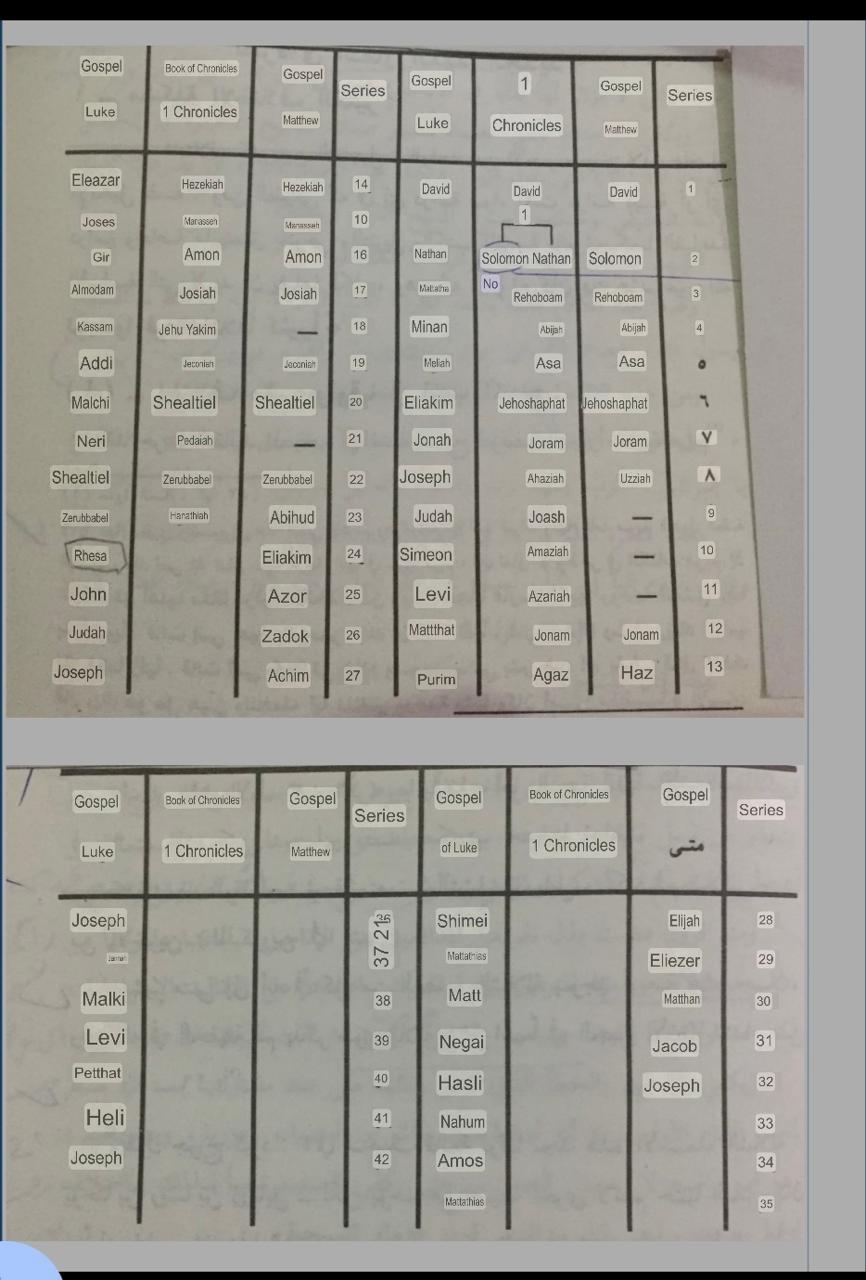 [LEFT]It is noted in this table - that in order to simplify the study - we have contented ourselves with tracing the lineage of Solomon, son of David, as it appears in the Book of Chronicles up to series number (23) only... and we have disregarded tracing the lineage of Nathan, son of David. Also, the lineages that were replaced by (-) under the Gospel of Matthew only mean names of fathers that were mistakenly omitted from the list written by Matthew... The previous table reveals a number of observations that are not hidden from anyone. The interpreters of the Gospels have spoken about these observations, and among what they said was the following: John Fenton says: “Matthew probably continued to rely on 1 Chronicles (3:5, 10-16) except that he omitted three generations between Joram and Jotham... and he omitted Johakim after Josiah... The genealogy in Luke runs through another son of David, Nathan...” Matthew was able to take the three names: Jeconiah, Shealtiel, and Zerubbaba from 1 Chronicles 3:16 and beyond. As for the rest of the names mentioned in his list, he had no written source, as far as we know. Luke also included Shealtiel and Zerubbabel in his list, but he did not mention any of the others (mentioned in Matthew). Matthew indicates that in each of the three ages there are fourteen generations... although in reality he only mentions thirteen names in the last generation starting from chapter (1:12-16) (Interpretation of the Gospel of Matthew, pp. 39-40) George Caird says: "In the middle of Luke's list we find these names: John, son of Rhesa, son of Zerubbabel... But John is another form of the name Hananiah, who was the son of Zerubbabel... This person, Rhesa, is not mentioned at all in (1 Chronicles 13:19)... but Rhesa is an Aramaic word meaning prince..." The error in Luke’s list can be traced back to the fact that the original list (from which it was copied) was arranged in the opposite order: “Zerubbabel the prince begot John” (Commentary on the Gospel of Luke, p. 19). In conclusion, regarding the lineage of Christ, if we consider the First Book of Chronicles as the main reference for the lineages of the fathers, we find the following: 1 - I made a mistake in the lineage of Christ when I actually omitted five names from it (series 9, 10, 11, 18, 21). 2- Luke made a mistake when he added Risa (series No. 24) between Zerubbabel and John. 3- Luke differed fundamentally with Matthew when he made Joseph, Mary’s fiancé, descend from Nathan, son of David... while Matthew made him descend from Solomon, son of David... ** Of course, when each person was copying and writing from different old, scattered lists, errors accumulated, and we found that the number of generations from David to Joseph according to Luke is 42 generations... and according to Matthew 23 generations. Centuries ago, a group of defenders of the Gospels - who considered them divine revelation - made strenuous attempts to reconcile Luke and Matthew, relying on Israelite traditions. However, all their attempts failed. The Gospels differ in the names of the disciples: Matthew says in his Gospel: 2 Now the names of the twelve apostles are these: first, Simon, who is called Peter, and Andrew his brother; James the son of Zebedee, and John his brother; 3 Philip and Bartholomew; Thomas and Matthew the tax collector; James the son of Alphaeus, and Lebbaeus, whose surname was 4 Simon the Cananite, and Judas Iscariot, who also betrayed Him. But Luke says: 13 And when it was day, He called His disciples to Himself; and from them He chose twelve whom He also named apostles: 14 Simon, whom He also named Peter, and Andrew his brother; James and John; Philip and Bartholomew; 15 Matthew and Thomas; James the son of Alphaeus, and Simon called the Zealot; 16 Judas the son of James, and Judas Iscariot who also became a traitor. John mentions the names of some of the disciples, including another Judas, other than the traitor, whom he says: “Judas Iscariot” (14:22). It is clear that there is a difference between what Matthew and Mark (3:16-19) mentioned on the one hand and Luke and John on the other hand. This is why George Caird says: “When the Gospels were written, there was no mere verification of the identity of the disciples.. Judas, son of James, does not appear in the list mentioned in either Matthew or Mark.. while his place was taken by Lebbaeus, called Thaddeus.” *** Here we must draw attention to the fact that Muhammad appeared under the sun of history and his companions numbered one hundred thousand or more... and their names and stories were known... so how could the writers of the Gospels be unable to verify the twelve disciples...? |
|
|
|
|
06-03-2025, 02:11 AM
|
#7 |
|
Senior Member
تاريخ التسجيل: Apr 2015
المشاركات: 7,853
|
C - The difference between Matthew and Mark regarding the story of the cleansing of the Temple and the fig tree: Matthew 10:1-23Let us read the Gospel text to understand the possible way in which "God" spoke to a tree. The Gospel says that Christ spoke to a tree. The Gospel of Matthew says: " Then Jesus went into the temple of God and drove out all those who bought and sold in the temple, .... Then He left them and went out of the city to Bethany, and He lodged there. (( Now in the morning,)) as He returned to the city, He was hungry. 19 And seeing a fig tree by the road, He came to it and found nothing on it but leaves, and said to it, "Let no fruit grow on you ever again." Immediately the fig tree withered away.." (21: 12-21 ) *** Let's take the conclusion from here: The incident of cursing the fig tree occurred after Jesus returned from purifying the Temple. Therefore, the time of the incident occurred after the Temple had been purified. However, the Gospel of Mark says about this incident: 12 Now the next day, when they had come out from Bethany, He was hungry. 13 And seeing from afar a fig tree having leaves, He went to see if perhaps He would find something on it. When He came to it, He found nothing but leaves, for it was not the season for figs. 14 In response Jesus said to it, "Let no one eat fruit from you ever again." And His disciples heard it. 15 So they came to Jerusalem. Then Jesus went into the temple and began to drive out those who bought and sold in the temple, and overturned the tables of the money changers and the seats of those who sold doves. 16 And He would not allow anyone to carry wares through the temple. 17 Then He taught, saying to them, "Is it not written, 'My house shall be called a house of prayer for all nations'? 18 And the scribes and chief priests heard it and sought how they might destroy Him; for they feared Him, because all the people were astonished at His teaching. 19 When evening had come, He went out of the city. 20 Now in the morning, as they passed by, they saw the fig tree dried up from the roots. 21 And Peter, remembering, said to Him, "Rabbi, look! The fig tree which You cursed has withered away." 22 " So Jesus answered and said to them, "Have faith in God. 23 For assuredly, I say to you, whoever says to this mountain, 'Be removed and be cast into the sea,' and does not doubt in his heart, but believes that those things he says will be done, he will have whatever he says. 24 Therefore I say to you, whatever things you ask when you pray, believe that you receive them, and you will have them. It is clear that in the Gospel of Matthew he cursed the fig tree after he finished purifying the temple. But here in Mark the incident happened first while he was leaving. So of course according to Matthew all of its events were supposed to happen on the same day. But in Mark he drew his attention to it the next day in two different accounts. One of the stories says that it was not the time for figs. This means that the knowledge of Christ, who was said to be God or the Son of God, did not reach the level of knowledge of the ordinary farmer who knows whether it was the time for figs or not. He did not know whether the tree he saw as far as the eye could see bore figs or not. Both stories say that this hungry god went to the tree and when he did not find any figs on it, he cursed it. *** Wasn't it from the tree's logic that you said to it, "My Lord, you created me without figs... Why do you curse me?" 2- The problem of predictions that are impossible to achieve. Next, we come to a serious issue, which is the problem of impossible predictions. What is agreed upon among religious scholars, especially those of the holy books, is that one of the definitions of a prophet is someone sent by God Almighty or someone who speaks by inspiration from his Creator, and that his narratives do not include any successors. It is certain that the prophet who confirms what happened in this world will confirm what he promised in the afterlife. However, when a prophecy is attributed to a prophet, or even more than one prophecy that proves that the worldly life we live has ended, then what will be the fate of the prophecies of the afterlife? What he promised will certainly not be fulfilled either.. I think this is an agreed upon rule.. Regarding the topic of prophecies in the Gospels, we find the following: A- The prediction that the end of the world will occur in the first century AD: The Gospels say that Jesus Christ: 1 And when He had called His twelve disciples to Him, He gave them power over unclean spirits, to cast them out, and to heal all kinds of sickness and all kinds of disease. and commanded them ..... "Behold, I send you out as sheep in the midst of wolves. Therefore be wise as serpents and harmless as doves...... When they persecute you in this city, flee to another. For assuredly, I say to you, you will not have gone through the cities of Israel before the Son of Man comes. ** That is, Christ's return to earth will occur before his disciples complete their preaching in the cities of Israel. *** It also happened before the contemporaries of Christ, who lived in the first half of the first century AD, had died: 27 For the Son of Man will come in the glory of His Father with His angels, and then He will reward each according to his works. 28 Assuredly, I say to you, there are some standing here who shall not taste death till they see the Son of Man coming in His kingdom." Matthew 16 In another way that confirms the above, the end of the world and the return of Christ to Earth must occur before the generation that lived in the first century AD perishes:
"29 "Immediately after the tribulation of those days the sun will be darkened, and the moon will not give its light; the stars will fall from heaven, and the powers of the heavens will be shaken. 30 Then the sign of the Son of Man will appear in heaven, and then all the tribes of the earth will mourn, and they will see the Son of Man coming on the clouds of heaven with power and great glory. ....... 34 Assuredly, I say to you, this generation will by no means pass away till all these things take place." Matthew 24" Both the Gospels of Mark 13:24-30 and Luke 21:25-32 agree with this serious report by Matthew. It is clear, as John Fenton says: "None of this happened as Matthew predicted..." (Commentary on the Gospel of Matthew, p. 21). Therefore, the predictions attributed to Christ in the Gospels about the end of the world in the first century AD are impossible to fulfill and cannot be defended. (b) The prediction that Judas the traitor will accompany Christ to the afterlife: In a dialogue that took place between Christ and his disciples about who would be saved in the afterlife, Peter asked his teacher about the reward of those who believe in him, and he said: " 27 Then Peter answered and said to Him, "See, we have left all and followed You. Therefore what shall we have?" 28 So Jesus said to them, "Assuredly I say to you, that in the regeneration, when the Son of Man sits on the throne of His glory, you who have followed Me will also sit on twelve thrones, judging the twelve tribes of Israel" (Matthew 19) ** Judas Iscariot was one of the twelve disciples to whom this prophecy was made. After his betrayal, he became known as the “son of perdition” because he was expelled from the company of Christ in this world and the hereafter. Thus, this prophecy became impossible to fulfill. If we go back to the equivalent of this paragraph in the Gospel of Luke, we find - as John Fenton says ** that he deleted the verse twelve, and perhaps that is because he was thinking of Judas Iscariot... (Interpretation of the Gospel of Matthew, p. 317)... C- The prediction that Christ would be buried in the earth for three days and three nights: Some Jews tried to confuse Jesus, so they said to him: "38 Then some of the scribes and Pharisees answered, saying, "Teacher, we want to see a sign from You." 39 " But He answered and said to them, "An evil and adulterous generation seeks after a sign, and no sign will be given to it except the sign of the prophet Jonah. 40 For as Jonah was three days and three nights in the belly of the great fish, so will the Son of Man be three days and three nights in the heart of the earth. " (Matthew 12) This saying is common in the Gospels and is mentioned repeatedly in most of them and in more than one place. It is mentioned in the Gospel of Mark in (8:31, 9:31, 10:34). It is mentioned in the Gospel of Luke, with an important difference that the reader will notice, in his saying: "29- ... He began to say, "This is an evil generation. It seeks a sign, and no sign will be given to it except the sign of Jonah the prophet. 30 For as Jonah became a sign to the Ninevites, so also the Son of Man will be to this generation." *** Luke here got rid of the story of three days and three nights.. The three days are mentioned in the Gospel of John (2:19).. And we read in the Book of Jonah (Jonah, peace be upon him) what happened to him: " Now the Lord had prepared a great fish to swallow Jonah. And Jonah was in the belly of the fish three days and three ........ So the Lord spoke to the fish, and it vomited Jonah onto dry land." ( Jonah 1 : 17 ) Jonah 2: 1-10) It is clear then that in order for this prophecy to be fulfilled, the crucified one must remain in the belly of the earth for three days and three nights. But if we go back to what the Gospels mention about the events of the crucifixion and resurrection, we find that the crucified one was taken down from the cross on Friday evening (the day of the crucifixion): "42 Now when evening had come, because it was the Preparation Day, that is, the day before the Sabbath, 43 Joseph of Arimathea, went in to Pilate and asked for the body of Jesus. ... and summoning the centurion, he asked him if He had been dead for some time. 45 So when he found out from the centurion, he granted the body to Joseph. 46 Then he bought fine linen, took Him down, and wrapped Him in the linen. And he laid Him in a tomb which had been hewn out of the rock, and rolled a stone against the door of the tomb. " (Mark 15) The disciples and followers of Christ discovered that the grave was empty in the early hours of Sunday morning. The Gospel of Matthew says about this: " Now after the Sabbath, as the first day of the week began to dawn, Mary Magdalene and the other Mary came to see the tomb. .... But the angel answered and said to the women, He is not here; for He is risen, as He said. " (Matthew 28: 1-6) The Gospel of John also says: 1 Now on the first day of the week Mary Magdalene went to the tomb early, while it was still dark, and saw that the stone had been taken away from the tomb." (John 20) By a simple calculation, we find that: The number of days the deceased spent in the belly of the earth (in the grave) = 1 day (Saturday). The number of nights the deceased spent in the belly of the earth (in the grave) = 2 nights.. (Saturday night and part of Sunday night at best) *** Thus, it became impossible to fulfill this prophecy that said that the dead person would remain in the belly of the earth for three days and three nights. There's more to come... Your brother, Al-Athram |
|
|
|
|
06-25-2025, 01:57 AM
|
#8 |
|
Senior Member
تاريخ التسجيل: Apr 2015
المشاركات: 7,853
|
In the name of God, the most gracious, the most merciful ** The crucifixion issue.. Firstly, let us discuss an important and vital matter, that is to say the crucifixion issue. One of the miracles of Holy Quran is that it absolutely negated the crucifixion of Jesus in one verse and one context. Verse (4:157) of the Noble Quran states: ((And [for] their saying, "Indeed, we have killed the Messiah, Jesus, the son of Mary, the messenger of Allah ." And they did not kill him, nor did they crucify him; Only a likeness of that was shown to them. And indeed, those who differ over it are in doubt about it. They have no knowledge of it except the following of assumption. And they did not kill him, for certain)). But when refuting other wrong beliefs, like (“Allah is Jesus”) or (Jesus is Allah’s son), the Noble Quran refuted and corrected such wrong beliefs in several verses and contexts, as the same are definitely deemed flagrant atheism. allocated to emphasize monotheism (Oneness of Allah) as first and foremost step for belief, and that was summarized in one conclusive and inclusive chapter, that is chapter 112 (Surat Al-Ikhlas), which says: ((1- Say: He is Allah, The one; 2- Allah, the Eternal, Absolute, 3- He begetteth not, Nor is He begotten, 4- And there is none like unto Him)). Now if we argued that Quran was not revealed by Allah or was invented by Prophet Mohammad, it will be more appropriate for Prophet Mohammad to adopt the idea of crucifixion in order to increase his followers, as such idea was common. And by that, he would also have attracted and persuaded the Christians, and would have overcome a lot of challenges and obstacles that prevent them from accepting Islam. In fact, it is easy for a Christian person to transform from certain Christian sect to another because such sects share many common ideologies. Also, in the past, a lot of Roman pagans converted to Christianity when they found many common ideologies between Christianity and their doctrines. Such as the concept of incarnated god, as well as other ideas and rituals, as I will demonstrate in detail hereinafter. However, a Christian converting to Islam is not as easy as the afore-mentioned situations; contrary, it is deemed a revolution in his life and belief because it changes and corrects many inherited concepts and beliefs. The Noble Quran did not go a long with the wrong tenets and beliefs of Christians; contrary, it has clearly corrected them; for example, believing that (God is Jesus himself) or (Jesus is God’s Son) is deemed an unforgivable disbelief and atheism. In the context of talking about killing Jesus in the Noble Quran, verse 4:155 states: ((And We cursed them (The Jews) for their breaking of the covenant and their disbelief in the signs of Allah and their killing of the prophets without right)). It did not state that Jesus was killed although the context is talking about Jesus and about the crimes of the Jews who used to kill prophets. The Noble Quran has completely negated that Jesus was killed or crucified, because that did not happen actually. The Noble Quran does not say except the truth, whether such truth conforms to the old or inherited beliefs or not. Before proceeding to discuss crucifixion and other issues, I would like to share an important rule that governs all issues and matters, that is “Anything that involves doubts or uncertainties cannot be taken as evidence”. According to the rules of justice, if the testimonies of two witnesses contained discrepancy or inconsistency, the judge shall disregard such two testimonies, unless a third witness comes and confirms the testimony of any of them; otherwise, there will be no justice. Now, let us discuss the story crucifixion as narrated in the Bibles. The story started by talking about the attempts to kill Jesus and ended by handing a person on the cross, crying helpless, followed by shrouding and burying him. 1- Judas agreed with the Jews and priests to deliver Jesus to them:- The Gospels differed on this simple incident, which is considered an introduction to the events of the crucifixion. The Gospel of Mark 14 says: “1 After two days it was the Passover and the Feast of Unleavened Bread. And the chief priests and the scribes sought how they might take Him by trickery and put Him to death. 2 But they said, "Not during the feast, lest there be an uproar of the people." 3 And being in Bethany at the house of Simon the leper, as He sat at the table, a woman came having an alabaster flask of very costly oil of spikenard. Then she broke the flask and poured it on His head. 4 But there were some who were indignant among themselves, and said, "Why was this fragrant oil wasted? 5 " For it might have been sold for more than three hundred denarii and given to the poor." And they criticized her sharply.” Matthew mentioned this incident in (26:6-9), Luke in (7:36-39), and John in (12:1-6), with differences between them in its timing and main elements. Nineham says about this story: ** We find St. John mentioning it a few days earlier than St. Mark. Likewise, St. Luke places it in a completely different context in Jesus' life. While in the Gospel of Mark it occurred in the home of Simon the leper from the village of Bethany, in the Gospel of John it occurred in the home of Mary, Martha, and Lazarus (Commentary on the Gospel of Mark, p. 370). The differences between the Gospels regarding this story can be summarized as follows: Location of the incident: In the house of Simon the leper (Mark and Matthew) - (In the house of the Pharisee’s (Luke) - In the house of the brothers Lazarus, Mary and Martha (John). The woman's character: Unknown (Mark and Matthew) - A sinner (Luke) - A righteous woman, Mary, the sister of Lazarus (John). What did you do? I anointed Jesus' head with perfume (Mark and Matthew) - I anointed his feet with perfume (Luke and John). Viewers' reaction: Some were outraged by her extravagance (Mark) - The disciples were outraged (Matthew) - The Pharisee questioned himself about Jesus' knowledge of the woman's identity (Luke) - Judas Iscariot was outraged by her extravagance (John). 2- Preparing for the last supper: Mark says: “12 Now on the first day of Unleavened Bread, when they killed the Passover lamb, His disciples said to Him, "Where do You want us to go and prepare, that You may eat the Passover?" 13 " And He sent out two of His disciples and said to them, "Go into the city, and a man will meet you carrying a pitcher of water; follow him. 14 Wherever he goes in, say to the master of the house, 'The Teacher says, "Where is the guest room in which I may eat the Passover with My disciples?" ' 15 Then he will show you a large upper room, furnished and prepared; there make ready for us." 16 So His disciples went out, and came into the city, and found it just as He had said to them; and they prepared the Passover. 17 In the evening He came with the twelve. “Mark 14 “ Nineham says: ** Most commentators believe that this passage, verses 12-16, was in fact a later addition to the narrative that Saint Mark follows in this part of his Gospel. Among the reasons for this belief are the following: 1- Describe the day on which the story is said to have taken place in a style not used by the average Jew who was a contemporary of it. 2- Jesus’ followers are described in every paragraph of this chapter (the fourteenth) as his disciples, while they are referred to insistently in this paragraph as the twelve. 3- The writer of verse (17) who says: "And when evening came, he came with {the twelve}" does not know anything about the journey of the two disciples mentioned in verse 13. If the writer of verse 17 had known the contents of that passage, he would have been talking about: {the ten, not the twelve}. That is, verse 17 should have read as follows: “And when evening came, he came with the ten.” (Interpretation of the Gospel of Mark: p. 379) Matthew differs from Mark in the story of preparing for the supper, as he makes all the disciples - as John Fenton says on page 414 of his commentary - participate in this preparation. He says: Jesus said to his disciples, “Go into the city to a certain man and say to him, ‘The Teacher says, “My time is near. I will celebrate the Passover at your house with my disciples.” So the disciples did as Jesus had commanded them and prepared the Passover. (26:17-19) 3 - The timing of the Last Supper and its impact on the crucifixion issue: John Fenton says: “Matthew (26:17-19) agrees with Mark (14:12-17) and Luke (22:8) that the Last Supper was the Passover. On the contrary, the Fourth Gospel makes the Passover eaten in the evening after Jesus’ death.” (John 18:28) as John Fenton says. Most scholars believe that the timing of Matthew, Mark (and Luke) is correct and that John changed it for doctrinal reasons. (Interpretation of the Gospel of Matthew, p. 415) This is because John decides that the last supper that Jesus attended with his disciples was before the Passover. He says: “1 Now before the feast of the Passover, when Jesus knew that His hour had come that He should depart from this world to the Father, having loved His own who were in the world, He loved them to the end. 2 And supper being ended, 3 Jesus, knowing that the Father had given all things into His hands, and that He had come from God and was going to God, 4 rose from supper and laid aside His garments, took a towel and girded Himself. 5 After that, He poured water into a basin and began to wash the disciples' feet, and to wipe them with the towel with which He was girded.” (John 13). John also states that they arrested Jesus on the evening of the day before eating the Passover.. in his saying: “28 Then they led Jesus from Caiaphas to the Praetorium, and it was early morning. But they themselves did not go into the Praetorium, lest they should be defiled, but that they might eat the Passover.” (John 18). *** The difference between the Gospels regarding the Last Supper and its timing resulted in their disagreement on a fundamental point that is considered one of the most important elements of the crucifixion issue... namely, determining the day of the crucifixion. If we take the accounts of Mark, Matthew and Luke, then Jesus would have eaten the Passover with his disciples on Thursday evening... and then he would have been arrested shortly after that on the same Thursday evening... and thus the crucifixion would have taken place on Friday. As for accepting John's account, it means that the arrest was on Wednesday evening... and that the crucifixion took place on Thursday... *** Did the crucifixion happen on Thursday or Friday?!! 4 - The Last Supper and the traitorous disciple: Mark says: “17 In the evening He came with the twelve. 18 Now as they sat and ate, Jesus said, "Assuredly, I say to you, one of you who eats with Me will betray Me." 19 And they began to be sorrowful, and to say to Him one by one, "Is it I?" And another said, "Is it I?" 20 " He answered and said to them, "It is one of the twelve, who dips with Me in the dish. 21 " The Son of Man indeed goes just as it is written of Him, but woe to that man by whom the Son of Man is betrayed! It would have been good for that man if he had never been born." (John 14). Matthew made some changes to Mark's account. Luke says: “ Then Satan entered Judas, surnamed Iscariot, who was numbered among the twelve. So he went his way and conferred with the chief priests and captains, how he might betray Him to them. So he promised and sought opportunity to betray Him to them in the absence of the multitude. …. When the hour had come, He sat down, and the twelve apostles with Him. Then He said to them, "With fervent desire I have desired to eat this Passover with you before I suffer; … But behold, the hand of My betrayer is with Me on the table. … Then they began to question among themselves, which of them it was who would do this thing. “ (Luke 22: 3-23 ) As for John’s account, there is a difference in it that is easy to notice - from what the other three Gospels narrated. He says: “" 21 When Jesus had said these things, He was troubled in spirit, and testified and said, "Most assuredly, I say to you, one of you will betray Me." 22 Then the disciples looked at one another, perplexed about whom He spoke. 23 Now there was leaning on Jesus' bosom one of His disciples, whom Jesus loved. 24 Simon Peter therefore motioned to him to ask who it was of whom He spoke. 25 Then, leaning back on Jesus' breast, he said to Him, "Lord, who is it?" 26 Jesus answered, "It is he to whom I shall give a piece of bread when I have dipped it." And having dipped the bread, He gave it to Judas Iscariot, the son of Simon. 27 Now after the piece of bread, Satan entered him. Then Jesus said to him, "What you do, do quickly." 28 But no one at the table knew for what reason He said this to him. 29 For some thought, because Judas had the money box, that Jesus had said to him, "Buy those things we need for the feast," or that he should give something to the poor. 30 Having received the piece of bread, he then went out immediately. And it was night. “(John 13). Regardless of the difference in the Gospels in Christ’s answer to his disciples about who the traitor was, the Gospel of Luke said: "He who dips in the dish" While the Gospel of John says: "To him I will dip the morsel and give it" But the important point regarding Judas’ betrayal is the difference between the Gospels regarding the incident of Satan’s entry into him. Here he decides that Satan entered Judas at least one day before the Last Supper (22:3-7). While John decides that Satan entered Judas after Jesus gave him the morsel (John 13:27)... during the Last Supper... This... and we will suffice with this amount in which we presented some elements of the crucifixion issue, which are: The anointing of Christ's body with perfume... then the preparation for the Last Supper - then the timing of the Last Supper and its impact on the crucifixion - and finally what was said about the Last Supper and the traitorous disciple... We will resume later, God willing, to complete the discussion of the crucifixion issue. And there's more to come... Your brother, Al-Athram |
|
|
|
|
07-14-2025, 12:52 AM
|
#9 |
|
Senior Member
تاريخ التسجيل: Apr 2015
المشاركات: 7,853
|
In the name of God, the most gracious, the most merciful And yet... can a scientific researcher be certain that there is now a gospel attributed to Christ? These contradictions exist in the gospels, despite their small size... because the gospels are very small in size... This is the size of the entire gospels. If it is proven that these Gospels contain some contradictions, even if it is just one contradiction...not a hundred contradictions...then that invalidates their being a revelation from God Almighty...because God Almighty said in the Qur’an that was revealed to an illiterate Messenger and to an illiterate nation that could neither read nor write, He said: "أَفَلَا يَتَدَبَّرُونَ ٱلۡقُرۡءَانَۚ وَلَوۡ كَانَ مِنۡ عِندِ غَيۡرِ ٱللَّهِ لَوَجَدُواْ فِيهِ ٱخۡتِلَٰفٗا كَثِيرٗا (82) " “Then do they not reflect upon the Qur'an? If it had been from [any] other than Allah, they would have found within it much contradiction.(82).” (surah An-Nisa') That is, if the Quran was not from Allah, they would have found many discrepancies within it. Therefore, every Muslim openly declares: “Bring us a single contradiction from the Holy Quran, with its 6236 verses.” No one would dare say that there is a single contradiction in the Quran. We, in your hands, can face any accusation, doubt, or suspicion that has been proven that there is a single contradiction in the Quran. As for the Gospels, you have seen that despite their small size, they are contradictory. In fact, there is a contradiction on a single page. I will give you an example of some of this contradiction on a single page. In the Gospel of Matthew, for example, we find dozens of these contradictions, and we can point out some of them without bias. Jesus Christ says to Peter: “18 And I also say to you that you are Peter, and on this rock I will build My church, and the gates of Hades shall not prevail against it. 19 And I will give you the keys of the kingdom of heaven, and whatever you bind on earth will be bound in heaven, and whatever you loose on earth will be loosed in heaven." (Matthew 16) So - Peter, Christ said to him: You are a rock, you are strong, and the demons cannot enter through you, nor can the gates of hell, and upon you I will build my church. Then He gave him an amazing promise or covenant that: “Whatever you make lawful on earth, I will make lawful in heaven.. And whatever you bind on earth, I will bind in heaven.. Whatever you do, I do, and whatever you want, I want.” That is, God's will is subordinate to Peter's will. This is what is stated in the Holy Quran, where God Almighty says: "وَقَالَتِ الْيَهُودُ عُزَيْرٌ ابْنُ اللَّهِ وَقَالَتِ النَّصَارَى الْمَسِيحُ ابْنُ اللَّهِ ۖ ذَٰلِكَ قَوْلُهُمْ بِأَفْوَاهِهِمْ ۖ يُضَاهِئُونَ قَوْلَ الَّذِينَ كَفَرُوا مِنْ قَبْلُ ۚ قَاتَلَهُمُ اللَّهُ ۚ أَنَّىٰ يُؤْفَكُونَ (30) "اتَّخَذُوا أَحْبَارَهُمْ وَرُهْبَانَهُمْ أَرْبَابًا مِنْ دُونِ اللَّهِ وَالْمَسِيحَ ابْنَ مَرْيَمَ وَمَا أُمِرُوا إِلَّا لِيَعْبُدُوا إِلَٰهًا وَاحِدًا ۖ لَا إِلَٰهَ إِلَّا هُوَ ۚ سُبْحَانَهُ عَمَّا يُشْرِكُونَ" “The Jews say, "Ezra is the son of Allah "; and the Christians say, "The Messiah is the son of Allah." That is their statement from their mouths; they imitate the saying of those who disbelieved [before them]. May Allah destroy them; how are they deluded?(30). They have taken their scholars and monks as lords besides Allah, and [also] the Messiah, the son of Mary. And they were not commanded except to worship one God; there is no deity except Him. Exalted is He above whatever they associate with Him.( surah At-Taubah) Adi bin Hatim Al-Ta’i, who was a Christian and later converted to Islam, said: “O Messenger of God, we did not worship them.” He understood that worship meant bowing at his feet or praying to him. The Messenger, peace and blessings be upon him, said to him: “Did they not make things lawful for you and unlawful, so you took their word for it?” He said: “Yes.” He said: “That is their worship instead of God.” * So, for anyone other than God alone to have the right to permit and prohibit is polytheism. Therefore, we find that Islam denies that the authority to permit and prohibit belongs to anyone other than God. It does not even belong to the Messenger Muhammad, peace and blessings be upon him. The Messenger does not possess the right to permit and prohibit except by revelation from God. God rebuked him when he forbade himself something, saying to him: "يَا أَيُّهَا النَّبِيُّ لِمَ تُحَرِّمُ مَا أَحَلَّ اللَّهُ لَكَ ۖ تَبْتَغِي مَرْضَاتَ أَزْوَاجِكَ ۚ وَاللَّهُ غَفُورٌ رَحِيمٌ(1). “O Prophet, why do you prohibit [yourself from] what Allah has made lawful for you, seeking the approval of your wives? And Allah is Forgiving and Merciful.” (surah At-Tahrim) In this Gospel text above, we find Peter's high status, but look at what he says at the end of the page? At the beginning of the page we find Peter - as the Gospel says on the tongue of Christ - is the rock on which Christ will build the edifice of his call.. and will bind it to him.. and he is a firm rock that the gates of hell cannot reach.. and in his hand are the keys of the kingdom of heaven.. Then the eye can hardly take in this great image of Peter until it encounters another completely opposite image that distorts this apostle and transforms him from a divine human into a scheming devil.. so suddenly.. and where is that? .. In the Gospel of Matthew itself, in the same chapter number 16, and after two verses - that is, only about two lines from the words of the Lord Christ announcing to him.. “21 From that time Jesus began to show to His disciples that He must go to Jerusalem, and suffer many things from the elders and chief priests and scribes, and be killed, and be raised the third day. 22 Then Peter took Him aside and began to rebuke Him, saying, "Far be it from You, Lord; this shall not happen to You!" 23 But He turned and said to Peter, "Get behind Me, Satan! You are an offense to Me, for you are not mindful of the things of God, but the things of men." (Matthew 16) ** Look at how at the beginning of the page Christ tells Peter: What you have done on earth, you will do in heaven... Then at the end of the page he tells him: You are a devil... There are many contradictions in the Gospels... Professor Ibrahim Khalil Ahmed... was a priest and professor of doctrine and theology at the Faculty of Theology... the head of all the churches of Upper Egypt in Egypt... says... The truth is that our work as missionaries was based on a document that came in the Second Epistle of Peter to confirm that the Torah and the Gospel are books inspired by God. So we used to say: “ 21 for prophecy never came by the will of man, but holy men of God spoke as they were moved by the Holy Spirit.”( 2 Peter 1) Of course, this text, which was spoken by Peter as it appeared in his second letter, will give the impression that the current Bible is a book inspired by God. The priest also addresses, in his work among Muslims, a verse from the Holy Quran in Surat Al Imran that says: " نَزَّلَ عَلَيْكَ الْكِتَابَ بِالْحَقِّ مُصَدِّقًا لِمَا بَيْنَ يَدَيْهِ وَأَنْزَلَ التَّوْرَاةَ وَالْإِنْجِيلَ (3) “He has sent down upon you, [O Muhammad], the Book in truth, confirming what was before it. And He revealed the Torah and the Gospel.(3)” surah Al-'Imran. The Quran is very precise. It did not mention the New Testament or the Old Testament, but it mentioned the Torah and the Bible. When the Quran came to mention the Old Testament and the New Testament in the book, what did it say? It said in Surat Al Imran: "قُلْ يَا أَهْلَ الْكِتَابِ تَعَالَوْا إِلَىٰ كَلِمَةٍ سَوَاءٍ بَيْنَنَا وَبَيْنَكُمْ" “64- Say, "O People of the Scripture, come to a word that is equitable between us and you “ So when the entire book was mentioned, the Qur’an began to give the correct and sound guidance.. and likewise in Surat An-Nisa.. God Almighty says: "يَا أَهْلَ الْكِتَابِ لَا تَغْلُوا فِي دِينِكُمْ وَلَا تَقُولُوا عَلَى اللَّهِ إِلَّا الْحَقَّ ۚ إِنَّمَا الْمَسِيحُ عِيسَى ابْنُ مَرْيَمَ رَسُولُ اللَّهِ وَكَلِمَتُهُ أَلْقَاهَا إِلَىٰ مَرْيَمَ وَرُوحٌ مِنْهُ ۖ فَآمِنُوا بِاللَّهِ وَرُسُلِهِ ۖ وَلَا تَقُولُوا ثَلَاثَةٌ ۚ انْتَهُوا خَيْرًا لَكُمْ ۚ إِنَّمَا اللَّهُ إِلَٰهٌ وَاحِدٌ ۖ سُبْحَانَهُ أَنْ يَكُونَ لَهُ وَلَدٌ ۘ لَهُ مَا فِي السَّمَاوَاتِ وَمَا فِي الْأَرْضِ ۗ وَكَفَىٰ بِاللَّهِ وَكِيلًا" “O People of the Scripture, do not commit excess in your religion or say about Allah except the truth. The Messiah, Jesus, the son of Mary, was but a messenger of Allah and His word which He directed to Mary and a soul [created at a command] from Him. So believe in Allah and His messengers. And do not say, "Three"; desist - it is better for you. Indeed, Allah is but one God. Exalted is He above having a son. To Him belongs whatever is in the heavens and whatever is on the earth. And sufficient is Allah as Disposer of affairs.(171).” (surah An-Nisa” And in Surat Al-Ma’idah, God Almighty also says about the People of the Book: "يَا أَهْلَ الْكِتَابِ قَدْ جَاءَكُمْ رَسُولُنَا يُبَيِّنُ لَكُمْ كَثِيرًا مِمَّا كُنْتُمْ تُخْفُونَ مِنَ الْكِتَابِ وَيَعْفُو عَنْ كَثِيرٍ ۚ قَدْ جَاءَكُمْ مِنَ اللَّهِ نُورٌ وَكِتَابٌ مُبِينٌ" “15- O People of the Scripture, there has come to you Our Messenger making clear to you much of what you used to conceal of the Scripture and overlooking much. There has come to you from Allah a light and a clear Book.” (surah Al-Ma'idah). ** So, when the reference was made to the Book, the reference was made to point out the correction. But when the reference was made to the Torah and the Gospel, the reference was made to confirm it, without mentioning either the Old Testament or the New Testament. Let us move from this to the Gospels themselves... and let us contemplate the Gospel of Luke itself... Was it inspired by God? Or was it under the influence of God Almighty's revelation? Luke says (1:1-4): “1 Inasmuch as many have taken in hand to set in order a narrative of those things which have been fulfilled among us, 2 just as those who from the beginning were eyewitnesses and ministers of the word delivered them to us, 3 it seemed good to me also, having had perfect understanding of all things from the very first, to write to you an orderly account, most excellent Theophilus, 4 that you may know the certainty of those things in which you were instructed.” *** He said: As those who were from the beginning handed it down to us.. and he did not say inspired by the Holy Spirit.. * Luke was not one of the twelve disciples who were with Christ. This is a point that has weight in assessing the situation. Then when we come to Saul, who later became known as Paul, we find in (Chapter 7:8) of the First Epistle to the Corinthians) he says in paragraph 8: “8 But I say to the unmarried and to the widows: It is good for them if they remain even as I am; “ These words are from Paul himself... and he wants people to remain unmarried like him... then he says: “10 Now to the married I command, yet not I but the Lord: A wife is not to depart from her husband.” This is separation without divorce.. and when you move forward a little we find him saying: "12 But to the rest I, not the Lord, say: " Sometimes he says, "Our Lord said," and other times he says, "I say." So it is as if he is on the same level as God - Glory be to Him - in the Book. Moreover, he makes it permissible for a believing woman to marry a polytheist. This is a great danger to the marital life between a believing woman and a polytheist man, as he says: “13 And a woman who has a husband who does not believe, if he is willing to live with her, let her not divorce him.” These are Paul's words... Was this man awake when he came to correct the situation? But when he came to, we find him saying: “14 Do not be unequally yoked together with unbelievers. For what fellowship has righteousness with lawlessness? And what communion has light with darkness? 15 And what accord has Christ with Belial? Or what part has a believer with an unbeliever? 16 And what agreement has the temple of God with idols? For you* are the temple of the living God. As God has said: "I will dwell in them And walk among them. I will be their God, And they shall be My people." 28916 18 "I will be a Father to you, And you shall be My sons and daughters, Says the Lord Almighty."*” This statement came in the second letter to the Corinthians, and it came in (Chapter 6: 14-18). * So in the first epistle he says... and the woman who has an unbelieving husband and is willing for him to live with her, she should not leave him... but in the second epistle he says... "Separate yourselves." This is undoubtedly a fluctuation in the words of the holy books that are supposed to be believed absolutely? We come to Paul and the virgins and we find him also saying in the First Epistle to the Corinthians: "25 Now concerning virgins: I have no commandment from the Lord; yet I give judgment as one whom the Lord in His mercy has made trustworthy. 26 I suppose therefore that this is good because of the present distress--that it is good for a man to remain as he is" I believe that speculation in the Holy Books is something very terrible that a person cannot rely on.. Moreover, marriage in Christianity does not dissolve except by death.. If it happens that a woman marries a man and she hates him and wants to get rid of him in any honorable way, she says: When he dies, she can get married. So the woman remains waiting for the hour of death so that she can get rid of the ominous man who was a nightmare in her life.. So what does Paul say: " 39 A wife is bound by law as long as her husband lives; but if her husband dies, she is at liberty to be married to whom she wishes, only in the Lord. 40 But she is happier if she remains as she is, according to my judgment--and I think I also have the Spirit of God." He does not believe himself whether he has the Spirit of God or not. When a man like Paul says such things, it gives us terrible doubt about what is stated in the New Testament. There's more to come... Your brother, Al-Athram |
|
|
|
|
08-23-2025, 12:42 AM
|
#10 |
|
Senior Member
تاريخ التسجيل: Apr 2015
المشاركات: 7,853
|
In the name of God, the most gracious, the most merciful When we come to the Old Testament and see the tricks that took place in the New Testament, we find that the Torah, which is the first five books that Moses gave to the Levites, we find the following: When Moses had finished writing the words of this law in a book to the end, Moses commanded the Levites who carried the ark of the covenant of the Lord, saying, “Take this book of the law and put it beside the ark of the covenant of the Lord to you, that it may be a witness against you there. For I know your rebellion and your stiff necks. Behold, while I am still alive with you this day, you have rebelled against the Lord; how much more after my death?” (Deuteronomy 31:24-27) This is how our master Moses confirms to the generations that the Jews are a rebellious people not only against Moses, but also against God, the Creator of the people of Israel. In the Book of Deuteronomy, before the conclusion, we find strange words that say in (Chapter 34: 5-7): “So Moses the servant of the Lord died there in the land of Moab, according to the word of the Lord. And He buried him in a valley in the land of Moab”, * Can a dead person write? ** If Moses died, how could he write these books and say, "I died and such-and-such happened?" *** So, there is no doubt that this statement has been exaggerated, and that the Torah was written during a time other than Moses', and what happened to it happened. In addition, by studying the Torah and the Bible historically, we will be completely reassured that the Torah in general was destroyed. In the history of Israel, we find that Nebuchadnezzar entered the temple with his army, destroyed it, and took all the possessions, including the holy books and vessels, and went with them to Babylon. Therefore, it is historically proven that the Torah written by Moses was completely lost. When Cyrus, the king of Persia, ordered the return of the Israelites to Palestine, Ezra and Nehemiah began to rewrite the Torah from memory. ** We cannot believe the whole Torah and the Bible.. nor can we disbelieve them all.. because the human factor is present in these books. But as a human being (Ibrahim Khalil Ahmed), God guided me to Islam. I was a priest and I was not guided to Islam easily. I must have a strong argument. The books from Moses to Jesus prophesied about our master, the Messenger of God, may God bless him and grant him peace. We find in Surat An-Nisa, verse (82), God Almighty says: أَفَلَا يَتَدَبَّرُونَ الْقُرْآنَ ۚ وَلَوْ كَانَ مِنْ عِنْدِ غَيْرِ اللَّهِ لَوَجَدُوا فِيهِ اخْتِلَافًا كَثِيرًا” Then do they not reflect upon the Qur'an? If it had been from [any] other than Allah, they would have found within it much contradiction. Not all people are supposed to be scholars and devote their time to study and comparison. However, I believe that what I have written to you from Paul's letters to the Corinthians demonstrates the presence of the human element in the New Testament. We find the Messenger, may God bless him and grant him peace, saying, “I am only a human being,” and he did not say, “I am a god.” The Qur’an says: "قُلْ إِنَّمَا أَنَا بَشَرٌ مِثْلُكُمْ يُوحَىٰ إِلَيَّ أَنَّمَا إِلَٰهُكُمْ إِلَٰهٌ وَاحِدٌ ۖ فَمَنْ كَانَ يَرْجُو لِقَاءَ رَبِّهِ فَلْيَعْمَلْ عَمَلًا صَالِحًا وَلَا يُشْرِكْ بِعِبَادَةِ رَبِّهِ أَحَدًا(110)" Say, "I am only a man like you, to whom has been revealed that your god is one God. So whoever would hope for the meeting with his Lord - let him do righteous work and not associate in the worship of his Lord anyone.(110)" (surah Al-Kahf) The Qur’an challenges all creatures, saying: "قُلْ لَئِنِ اجْتَمَعَتِ الْإِنْسُ وَالْجِنُّ عَلَىٰ أَنْ يَأْتُوا بِمِثْلِ هَٰذَا الْقُرْآنِ لَا يَأْتُونَ بِمِثْلِهِ وَلَوْ كَانَ بَعْضُهُمْ لِبَعْضٍ ظَهِيرًا" "Say, "If mankind and the jinn gathered in order to produce the like of this Qur'an, they could not produce the like of it, even if they were to each other assistants.(88)" surah Al-Isra *** So we can conclude that the Gospel of Christ does not exist? This is certain. Here we ask: How does the Holy Qur'an say: "وَلْيَحْكُمْ أَهْلُ الْإِنْجِيلِ بِمَا أَنْزَلَ اللَّهُ فِيهِ ۚ " "And let the People of the Gospel judge by what Allah has revealed therein(47). surah Al-Ma'idah “إِنَّا أَنْزَلْنَا التَّوْرَاةَ فِيهَا هُدًى وَنُورٌ ۚ يَحْكُمُ بِهَا النَّبِيُّونَ الَّذِينَ أَسْلَمُوا لِلَّذِينَ هَادُوا” “Indeed, We sent down the Torah, in which was guidance and light. The prophets who submitted [to Allah] judged by it for the Jews,(44). surah Al-Ma'idah And God Almighty says: " قُلْ فَأْتُوا بِالتَّوْرَاةِ فَاتْلُوهَا إِنْ كُنْتُمْ صَادِقِينَ" "So bring the Torah and recite it, if you should be truthful(93)." surah Al-'Imran Which Torah does he mean...and which Gospel? The existing Torah is filled with words attributed to Moses, but not everything in it is the words of Moses. Likewise, the Bible is filled with words attributed to Christ, but not everything in it is the words of Christ. We can sum up the answer in that when God Almighty said: “Indeed, We sent down the Torah, in which was guidance and light (93).” surah Al-'Imran "And let the People of the Gospel judge by what Allah has revealed therein(47). surah Al-Ma'idah Our Lord Almighty said to His Messenger, may God bless him and grant him peace... "وَأَنْزَلْنَا إِلَيْكَ الْكِتَابَ بِالْحَقِّ مُصَدِّقًا لِمَا بَيْنَ يَدَيْهِ مِنَ الْكِتَابِ وَمُهَيْمِنًا عَلَيْهِ" “And We have revealed to you, [O Muhammad], the Book in truth, confirming that which preceded it of the Scripture and as a criterion over it.(48)” surah Al-Ma'idah. So the only reference for what is authentic in the Bible, what is authentic in the Torah, and what God is pleased with, is the Holy Quran. Whatever the Quran confirms and approves is true, whatever the Quran abrogates has been abrogated, and whatever the Holy Quran rejects is false. There's more to come... Your brother, Al-Athram |
|
|
|
|
|
|
|
 |
 |


 العرض العادي

