

|
|
|
 |
 |
|||||||||
|
||||||||||
 |
 |
|||||||||

 |
|
|
أدوات الموضوع | انواع عرض الموضوع |
|
|
 05-11-2025, 12:59 AM
|
#1 |
|
Senior Member
تاريخ التسجيل: Apr 2015
المشاركات: 7,853
|

In the Name of God, the Most Gracious, the Most Merciful A Look at the Books of the New Testament 1- The Problem of Extensive Differences: There are many differences between the Gospels: one from the other... and differences within the Gospel itself. It is natural that in any study, whether religious or any other study, especially those related to revelation, revelation, and the Holy Scriptures, we are governed by the fundamental rule that must be accepted by all... namely: " ولَوْ كَانَ مِنْ عِنْدِ غَيْرِ اللَّهِ لَوَجَدُوا فِيهِ اخْتِلَافًا كَثِيرًا (82) " سورة النساء " Then do they not reflect upon the Qur'an? If it had been from [any] other than Allah, they would have found within it much contradiction.surah An-Nisa' (82) (1) - The difference between Matthew and Luke regarding the genealogy of Christ: Christian tradition has attributed Christ to Joseph the carpenter, the fiancé of Mary. *** A shameful accusation, attributed to this noble prophet, of which he is absolutely innocent, and an accusation against his mother, the chaste and pure Virgin Mary. God Almighty has told us about her and her son in Surah Maryam. God Almighty says: وَاذْكُرْ فِي الْكِتَابِ مَرْيَمَ إِذِ انْتَبَذَتْ مِنْ أَهْلِهَا مَكَانًا شَرْقِيًّا And mention, [O Muhammad], in the Book [the story of] Mary, when she withdrew from her family to a place toward the east(16). فَاتَّخَذَتْ مِنْ دُونِهِمْ حِجَابًا فَأَرْسَلْنَا إِلَيْهَا رُوحَنَا فَتَمَثَّلَ لَهَا بَشَرًا سَوِيًّا And she took, in seclusion from them, a screen. Then We sent to her Our Angel, and he represented himself to her as a well-proportioned man. قَالَتْ إِنِّي أَعُوذُ بِالرَّحْمَظ°نِ مِنْكَ إِنْ كُنْتَ تَقِيًّا She said, "Indeed, I seek refuge in the Most Merciful from you, [so leave me], if you should be fearing of Allah." قَالَ إِنَّمَا أَنَا رَسُولُ رَبِّكِ لِأَهَبَ لَكِ غُلَامًا زَكِيًّا He said, "I am only the messenger of your Lord to give you [news of] a pure boy." قَالَتْ أَنَّىظ° يَكُونُ لِي غُلَامٌ وَلَمْ يَمْسَسْنِي بَشَرٌ وَلَمْ أَكُ بَغِيًّا She said, "How can I have a boy while no man has touched me and I have not been unchaste?" قَالَ كَذَظ°لِكِ قَالَ رَبُّكِ هُوَ عَلَيَّ هَيِّنٌ غ– وَلِنَجْعَلَهُ آيَةً لِلنَّاسِ وَرَحْمَةً مِنَّا غڑ وَكَانَ أَمْرًا مَقْضِيًّا He said, "Thus [it will be]; your Lord says, 'It is easy for Me, and We will make him a sign to the people and a mercy from Us. And it is a matter [already] decreed.' "(21) God Almighty said in surah At-Tahrim : وَمَرْيَمَ ابْنَتَ عِمْرَانَ الَّتِي أَحْصَنَتْ فَرْجَهَا فَنَفَخْنَا فِيهِ مِنْ رُوحِنَا وَصَدَّقَتْ بِكَلِمَاتِ رَبِّهَا وَكُتُبِهِ وَكَانَتْ مِنَ الْقَانِتِينَ And [the example of] Mary, the daughter of 'Imran, who guarded her chastity, so We blew into [her garment] through Our angel, and she believed in the words of her Lord and His scriptures and was of the devoutly obedient.(12) Here is Luke saying: 23 Now Jesus Himself began His ministry at about thirty years of age, being (as was supposed) the son of Joseph, the son of Heli, Matthew differed with Luke regarding the lineage of Christ. Matthew made him descend from Solomon, son of David, while Luke made him descend from another son of David, Nathan. The situation becomes clear by creating a table showing the genealogies mentioned by Matthew and Luke in comparison with the genealogies of the fathers mentioned in the books of the Old Testament, especially the Book of Chronicles, as follows: 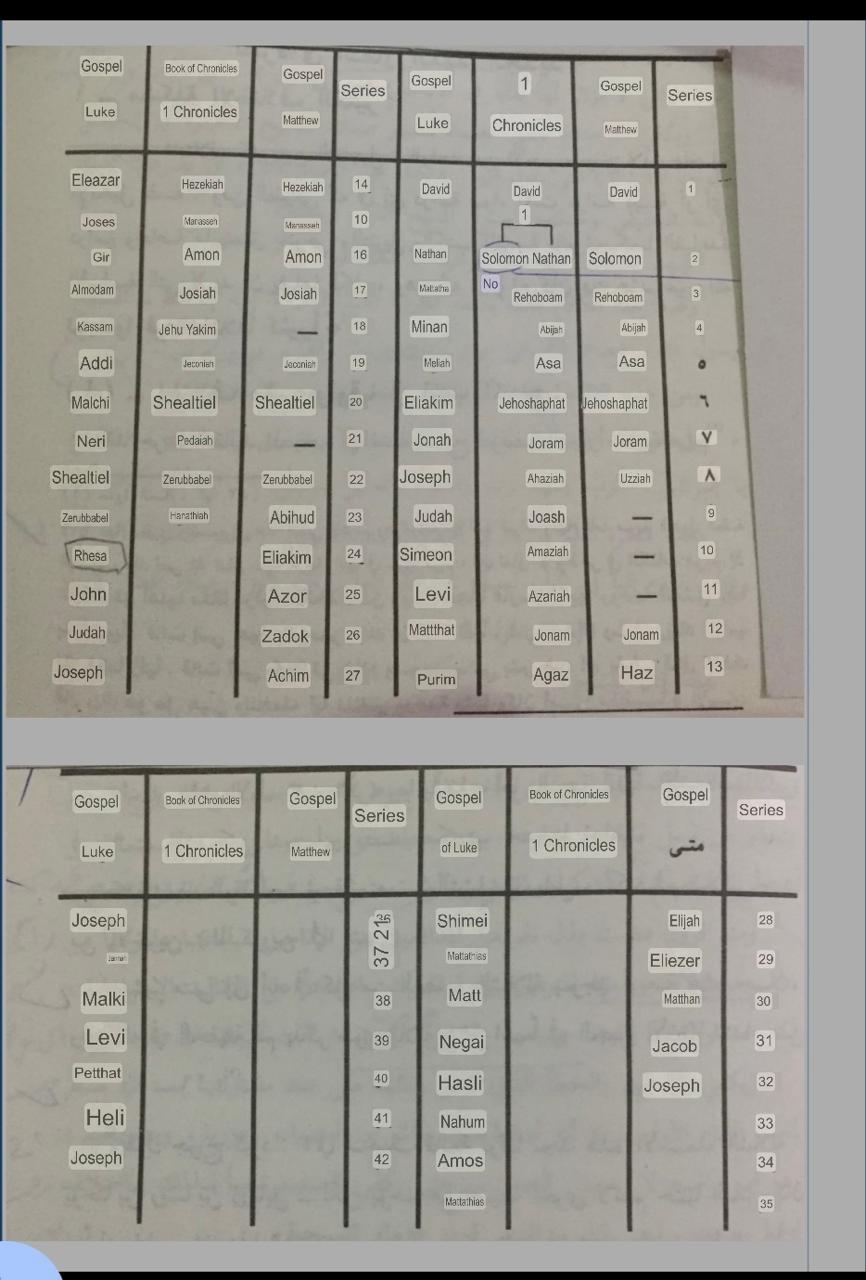 [LEFT]It is noted in this table - that in order to simplify the study - we have contented ourselves with tracing the lineage of Solomon, son of David, as it appears in the Book of Chronicles up to series number (23) only... and we have disregarded tracing the lineage of Nathan, son of David. Also, the lineages that were replaced by (-) under the Gospel of Matthew only mean names of fathers that were mistakenly omitted from the list written by Matthew... The previous table reveals a number of observations that are not hidden from anyone. The interpreters of the Gospels have spoken about these observations, and among what they said was the following: John Fenton says: “Matthew probably continued to rely on 1 Chronicles (3:5, 10-16) except that he omitted three generations between Joram and Jotham... and he omitted Johakim after Josiah... The genealogy in Luke runs through another son of David, Nathan...” Matthew was able to take the three names: Jeconiah, Shealtiel, and Zerubbaba from 1 Chronicles 3:16 and beyond. As for the rest of the names mentioned in his list, he had no written source, as far as we know. Luke also included Shealtiel and Zerubbabel in his list, but he did not mention any of the others (mentioned in Matthew). Matthew indicates that in each of the three ages there are fourteen generations... although in reality he only mentions thirteen names in the last generation starting from chapter (1:12-16) (Interpretation of the Gospel of Matthew, pp. 39-40) George Caird says: "In the middle of Luke's list we find these names: John, son of Rhesa, son of Zerubbabel... But John is another form of the name Hananiah, who was the son of Zerubbabel... This person, Rhesa, is not mentioned at all in (1 Chronicles 13:19)... but Rhesa is an Aramaic word meaning prince..." The error in Luke’s list can be traced back to the fact that the original list (from which it was copied) was arranged in the opposite order: “Zerubbabel the prince begot John” (Commentary on the Gospel of Luke, p. 19). In conclusion, regarding the lineage of Christ, if we consider the First Book of Chronicles as the main reference for the lineages of the fathers, we find the following: 1 - I made a mistake in the lineage of Christ when I actually omitted five names from it (series 9, 10, 11, 18, 21). 2- Luke made a mistake when he added Risa (series No. 24) between Zerubbabel and John. 3- Luke differed fundamentally with Matthew when he made Joseph, Mary’s fiancé, descend from Nathan, son of David... while Matthew made him descend from Solomon, son of David... ** Of course, when each person was copying and writing from different old, scattered lists, errors accumulated, and we found that the number of generations from David to Joseph according to Luke is 42 generations... and according to Matthew 23 generations. Centuries ago, a group of defenders of the Gospels - who considered them divine revelation - made strenuous attempts to reconcile Luke and Matthew, relying on Israelite traditions. However, all their attempts failed. The Gospels differ in the names of the disciples: Matthew says in his Gospel: 2 Now the names of the twelve apostles are these: first, Simon, who is called Peter, and Andrew his brother; James the son of Zebedee, and John his brother; 3 Philip and Bartholomew; Thomas and Matthew the tax collector; James the son of Alphaeus, and Lebbaeus, whose surname was 4 Simon the Cananite, and Judas Iscariot, who also betrayed Him. But Luke says: 13 And when it was day, He called His disciples to Himself; and from them He chose twelve whom He also named apostles: 14 Simon, whom He also named Peter, and Andrew his brother; James and John; Philip and Bartholomew; 15 Matthew and Thomas; James the son of Alphaeus, and Simon called the Zealot; 16 Judas the son of James, and Judas Iscariot who also became a traitor. John mentions the names of some of the disciples, including another Judas, other than the traitor, whom he says: “Judas Iscariot” (14:22). It is clear that there is a difference between what Matthew and Mark (3:16-19) mentioned on the one hand and Luke and John on the other hand. This is why George Caird says: “When the Gospels were written, there was no mere verification of the identity of the disciples.. Judas, son of James, does not appear in the list mentioned in either Matthew or Mark.. while his place was taken by Lebbaeus, called Thaddeus.” *** Here we must draw attention to the fact that Muhammad appeared under the sun of history and his companions numbered one hundred thousand or more... and their names and stories were known... so how could the writers of the Gospels be unable to verify the twelve disciples...? |

|

|
|
06-03-2025, 02:11 AM
|
#2 |
|
Senior Member
تاريخ التسجيل: Apr 2015
المشاركات: 7,853
|
C - The difference between Matthew and Mark regarding the story of the cleansing of the Temple and the fig tree: Matthew 10:1-23Let us read the Gospel text to understand the possible way in which "God" spoke to a tree. The Gospel says that Christ spoke to a tree. The Gospel of Matthew says: " Then Jesus went into the temple of God and drove out all those who bought and sold in the temple, .... Then He left them and went out of the city to Bethany, and He lodged there. (( Now in the morning,)) as He returned to the city, He was hungry. 19 And seeing a fig tree by the road, He came to it and found nothing on it but leaves, and said to it, "Let no fruit grow on you ever again." Immediately the fig tree withered away.." (21: 12-21 ) *** Let's take the conclusion from here: The incident of cursing the fig tree occurred after Jesus returned from purifying the Temple. Therefore, the time of the incident occurred after the Temple had been purified. However, the Gospel of Mark says about this incident: 12 Now the next day, when they had come out from Bethany, He was hungry. 13 And seeing from afar a fig tree having leaves, He went to see if perhaps He would find something on it. When He came to it, He found nothing but leaves, for it was not the season for figs. 14 In response Jesus said to it, "Let no one eat fruit from you ever again." And His disciples heard it. 15 So they came to Jerusalem. Then Jesus went into the temple and began to drive out those who bought and sold in the temple, and overturned the tables of the money changers and the seats of those who sold doves. 16 And He would not allow anyone to carry wares through the temple. 17 Then He taught, saying to them, "Is it not written, 'My house shall be called a house of prayer for all nations'? 18 And the scribes and chief priests heard it and sought how they might destroy Him; for they feared Him, because all the people were astonished at His teaching. 19 When evening had come, He went out of the city. 20 Now in the morning, as they passed by, they saw the fig tree dried up from the roots. 21 And Peter, remembering, said to Him, "Rabbi, look! The fig tree which You cursed has withered away." 22 " So Jesus answered and said to them, "Have faith in God. 23 For assuredly, I say to you, whoever says to this mountain, 'Be removed and be cast into the sea,' and does not doubt in his heart, but believes that those things he says will be done, he will have whatever he says. 24 Therefore I say to you, whatever things you ask when you pray, believe that you receive them, and you will have them. It is clear that in the Gospel of Matthew he cursed the fig tree after he finished purifying the temple. But here in Mark the incident happened first while he was leaving. So of course according to Matthew all of its events were supposed to happen on the same day. But in Mark he drew his attention to it the next day in two different accounts. One of the stories says that it was not the time for figs. This means that the knowledge of Christ, who was said to be God or the Son of God, did not reach the level of knowledge of the ordinary farmer who knows whether it was the time for figs or not. He did not know whether the tree he saw as far as the eye could see bore figs or not. Both stories say that this hungry god went to the tree and when he did not find any figs on it, he cursed it. *** Wasn't it from the tree's logic that you said to it, "My Lord, you created me without figs... Why do you curse me?" 2- The problem of predictions that are impossible to achieve. Next, we come to a serious issue, which is the problem of impossible predictions. What is agreed upon among religious scholars, especially those of the holy books, is that one of the definitions of a prophet is someone sent by God Almighty or someone who speaks by inspiration from his Creator, and that his narratives do not include any successors. It is certain that the prophet who confirms what happened in this world will confirm what he promised in the afterlife. However, when a prophecy is attributed to a prophet, or even more than one prophecy that proves that the worldly life we live has ended, then what will be the fate of the prophecies of the afterlife? What he promised will certainly not be fulfilled either.. I think this is an agreed upon rule.. Regarding the topic of prophecies in the Gospels, we find the following: A- The prediction that the end of the world will occur in the first century AD: The Gospels say that Jesus Christ: 1 And when He had called His twelve disciples to Him, He gave them power over unclean spirits, to cast them out, and to heal all kinds of sickness and all kinds of disease. and commanded them ..... "Behold, I send you out as sheep in the midst of wolves. Therefore be wise as serpents and harmless as doves...... When they persecute you in this city, flee to another. For assuredly, I say to you, you will not have gone through the cities of Israel before the Son of Man comes. ** That is, Christ's return to earth will occur before his disciples complete their preaching in the cities of Israel. *** It also happened before the contemporaries of Christ, who lived in the first half of the first century AD, had died: 27 For the Son of Man will come in the glory of His Father with His angels, and then He will reward each according to his works. 28 Assuredly, I say to you, there are some standing here who shall not taste death till they see the Son of Man coming in His kingdom." Matthew 16 In another way that confirms the above, the end of the world and the return of Christ to Earth must occur before the generation that lived in the first century AD perishes:
"29 "Immediately after the tribulation of those days the sun will be darkened, and the moon will not give its light; the stars will fall from heaven, and the powers of the heavens will be shaken. 30 Then the sign of the Son of Man will appear in heaven, and then all the tribes of the earth will mourn, and they will see the Son of Man coming on the clouds of heaven with power and great glory. ....... 34 Assuredly, I say to you, this generation will by no means pass away till all these things take place." Matthew 24" Both the Gospels of Mark 13:24-30 and Luke 21:25-32 agree with this serious report by Matthew. It is clear, as John Fenton says: "None of this happened as Matthew predicted..." (Commentary on the Gospel of Matthew, p. 21). Therefore, the predictions attributed to Christ in the Gospels about the end of the world in the first century AD are impossible to fulfill and cannot be defended. (b) The prediction that Judas the traitor will accompany Christ to the afterlife: In a dialogue that took place between Christ and his disciples about who would be saved in the afterlife, Peter asked his teacher about the reward of those who believe in him, and he said: " 27 Then Peter answered and said to Him, "See, we have left all and followed You. Therefore what shall we have?" 28 So Jesus said to them, "Assuredly I say to you, that in the regeneration, when the Son of Man sits on the throne of His glory, you who have followed Me will also sit on twelve thrones, judging the twelve tribes of Israel" (Matthew 19) ** Judas Iscariot was one of the twelve disciples to whom this prophecy was made. After his betrayal, he became known as the “son of perdition” because he was expelled from the company of Christ in this world and the hereafter. Thus, this prophecy became impossible to fulfill. If we go back to the equivalent of this paragraph in the Gospel of Luke, we find - as John Fenton says ** that he deleted the verse twelve, and perhaps that is because he was thinking of Judas Iscariot... (Interpretation of the Gospel of Matthew, p. 317)... C- The prediction that Christ would be buried in the earth for three days and three nights: Some Jews tried to confuse Jesus, so they said to him: "38 Then some of the scribes and Pharisees answered, saying, "Teacher, we want to see a sign from You." 39 " But He answered and said to them, "An evil and adulterous generation seeks after a sign, and no sign will be given to it except the sign of the prophet Jonah. 40 For as Jonah was three days and three nights in the belly of the great fish, so will the Son of Man be three days and three nights in the heart of the earth. " (Matthew 12) This saying is common in the Gospels and is mentioned repeatedly in most of them and in more than one place. It is mentioned in the Gospel of Mark in (8:31, 9:31, 10:34). It is mentioned in the Gospel of Luke, with an important difference that the reader will notice, in his saying: "29- ... He began to say, "This is an evil generation. It seeks a sign, and no sign will be given to it except the sign of Jonah the prophet. 30 For as Jonah became a sign to the Ninevites, so also the Son of Man will be to this generation." *** Luke here got rid of the story of three days and three nights.. The three days are mentioned in the Gospel of John (2:19).. And we read in the Book of Jonah (Jonah, peace be upon him) what happened to him: " Now the Lord had prepared a great fish to swallow Jonah. And Jonah was in the belly of the fish three days and three ........ So the Lord spoke to the fish, and it vomited Jonah onto dry land." ( Jonah 1 : 17 ) Jonah 2: 1-10) It is clear then that in order for this prophecy to be fulfilled, the crucified one must remain in the belly of the earth for three days and three nights. But if we go back to what the Gospels mention about the events of the crucifixion and resurrection, we find that the crucified one was taken down from the cross on Friday evening (the day of the crucifixion): "42 Now when evening had come, because it was the Preparation Day, that is, the day before the Sabbath, 43 Joseph of Arimathea, went in to Pilate and asked for the body of Jesus. ... and summoning the centurion, he asked him if He had been dead for some time. 45 So when he found out from the centurion, he granted the body to Joseph. 46 Then he bought fine linen, took Him down, and wrapped Him in the linen. And he laid Him in a tomb which had been hewn out of the rock, and rolled a stone against the door of the tomb. " (Mark 15) The disciples and followers of Christ discovered that the grave was empty in the early hours of Sunday morning. The Gospel of Matthew says about this: " Now after the Sabbath, as the first day of the week began to dawn, Mary Magdalene and the other Mary came to see the tomb. .... But the angel answered and said to the women, He is not here; for He is risen, as He said. " (Matthew 28: 1-6) The Gospel of John also says: 1 Now on the first day of the week Mary Magdalene went to the tomb early, while it was still dark, and saw that the stone had been taken away from the tomb." (John 20) By a simple calculation, we find that: The number of days the deceased spent in the belly of the earth (in the grave) = 1 day (Saturday). The number of nights the deceased spent in the belly of the earth (in the grave) = 2 nights.. (Saturday night and part of Sunday night at best) *** Thus, it became impossible to fulfill this prophecy that said that the dead person would remain in the belly of the earth for three days and three nights. There's more to come... Your brother, Al-Athram |
|
|
|
|
|
| أدوات الموضوع | |
| انواع عرض الموضوع | |
|
|
 |
 |


 العرض المتطور
